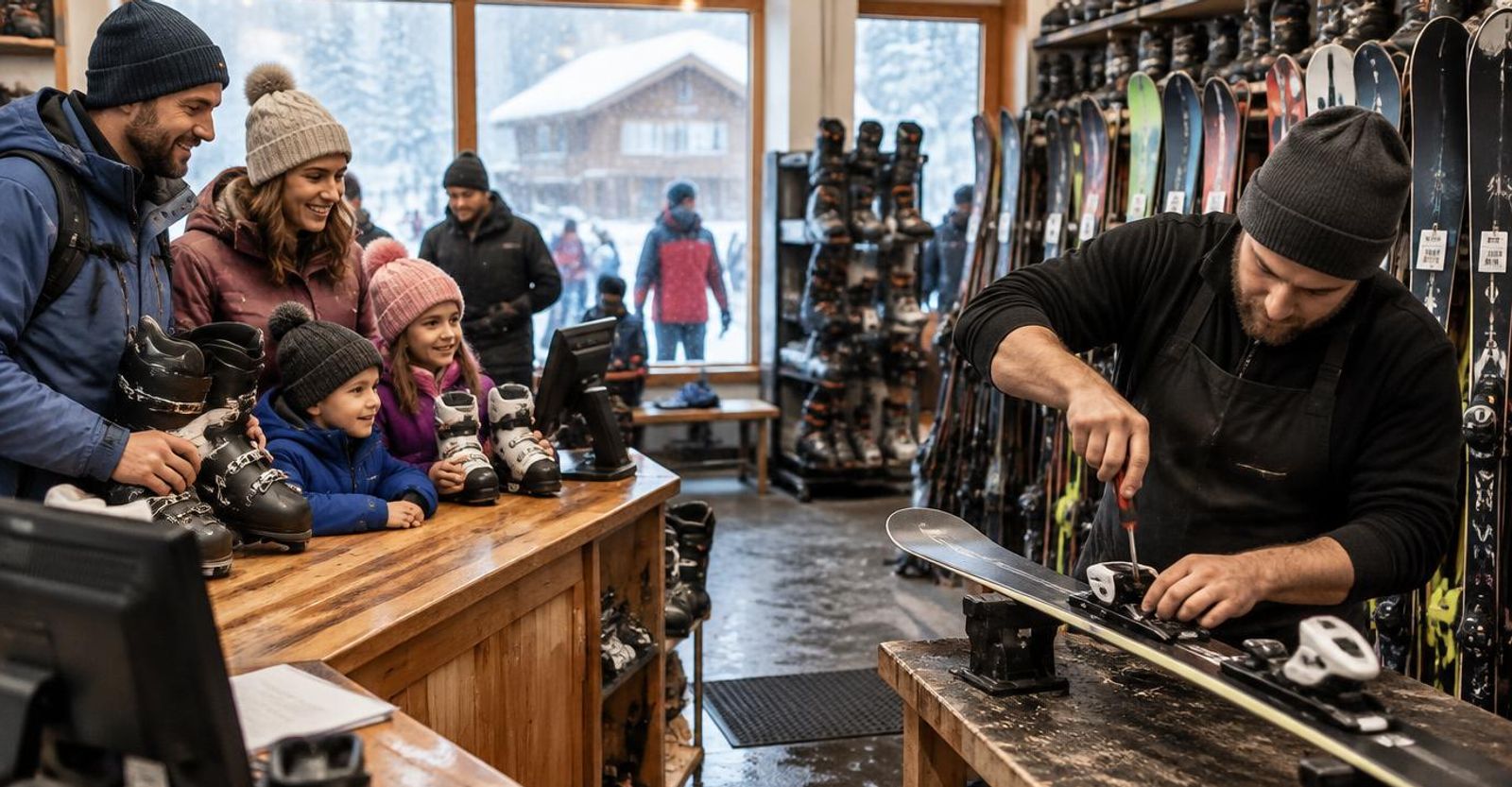
A ski rental counter at 8:15 on a holiday Saturday is one of the hardest places in the outdoor economy to slow anyone down. Families want boots fitted and bindings set before the lift line grows. Yet that same rush is when a rental shop takes on its biggest financial exposure of the day: hundreds of skis, boards, boots and helmets leaving the building with strangers.
This guide covers the operational side of that exposure: how to decide between deposits, card holds and post-return charges, what to disclose before an online booking is paid, what to record at check-out and check-in, and how to treat wear, damage, loss and late returns fairly. For the market context behind a busy season, see Ski Industry Statistics 2026.
Four ways to protect rental equipment
Most ski rental operations use some mix of four approaches. Each has a different effect on the guest, the counter and your cash flow.
What the card rules actually say about holds and later charges
Many operators talk about a "damage hold" as if it were a standard feature. The public Visa Core Rules and Visa Product and Service Rules (April 2026 edition) are more specific. Section 5.7.2.4 allows an estimated authorization when the final amount is not known, but it must be a genuine estimate of what the cardholder will spend, the cardholder must be told the amount and that further authorizations may follow, and it must not include any amount covering potential damage, theft or other delayed charges.
Separately, Section 5.8.8.3 lists merchant types that may process delayed charges for loss, theft or damage, including bicycle rental merchants and equipment rental and leasing merchants (MCC 7394). Under those conditions, the charge must relate to the rental period, must be the actual cost of repair or replacement or the insurance deductible, whichever is less, and an advance payment may not be used to pay for damage, theft or loss of use. The rules also describe documentation such as the rental agreement and a repair estimate.
Two practical points follow. First, ask your processor how your account is categorized and exactly how any hold or later charge is configured before you print it on your agreement. Second, Mastercard, American Express and other networks publish their own rules, so treat the Visa text as one important reference, not the whole picture.
A decision matrix for deposits and holds
The right level of protection depends mostly on four things: what the gear is worth, how long it is out, whether the guest is in front of you, and how likely it is to come back damaged or not at all. A shop renting entry-level kids' packages by the day faces a different problem than a demo centre sending carbon touring setups out for a week.
Example rental profiles for one mountain-town shop. These are illustrative planning examples, not recommended amounts or universal policy. Available options and consent requirements depend on your merchant setup, processor, card network rules and local law.
| Rental profile | Equipment value | Length and presence | Loss or damage risk | Illustrative approach |
|---|---|---|---|---|
| Kids' ski or board package | Low per item | Half day to day, guest present at pickup | Low to moderate, mostly wear | No deposit; signed agreement, ID and card details on file, documented post-return charge for genuine loss |
| Adult standard package, multi-day | Moderate | 3 to 7 days, guest present | Moderate, includes late returns | Card on file with clear terms; consider a disclosed authorization for the known rental total |
| Premium demo or performance skis | High | 1 to 3 days, guest present | Higher, edge and base damage, theft from cars | Refundable deposit or documented post-return charge, plus detailed condition record at check-out |
| Backcountry touring setup with skins and avalanche gear | Very high | Multi-day, often off-site | Highest, loss in terrain and non-return | Larger refundable deposit, ID check, serial numbers recorded, written damage and replacement schedule accepted in advance |
| Delivered or slope-side rentals booked online | Mixed | Guest may not be present at handover | Moderate, weaker evidence of condition at handover | Terms accepted online before payment, photos at delivery and pickup, documented post-return charge where permitted |
Fizel editorial framework. Illustrative only.
Deposit amounts, authorization amounts and later charges must follow your processor's setup and applicable card network rules.
What an online booking should show before payment
Advance online reservations matter most in holiday weeks, when popular boot sizes and junior skis can run out. They also move your terms conversation from the counter to the checkout page, which is the best time to get clear acceptance.
Price display rules differ by country and region. In Canada, the Competition Bureau's guidance on drip pricing explains that advertising a price that cannot be attained because of added mandatory fees can be deceptive. In the United States, California's SB 478 honest pricing law has required most businesses since July 1, 2024 to include all mandatory fees in listed prices, other than certain government taxes and shipping. The FTC's Rule on Unfair or Deceptive Fees applies to live-event tickets and short-term lodging, so it may reach resort packages that bundle lodging but does not cover a stand-alone rental shop. Other states and provinces have their own rules.
On the card side, Visa Section 5.4.2.5 says a merchant that restricts cancellations or refunds must disclose its policy before checkout online, with a "click to accept" button, checkbox or other acknowledgement. In a card-present sale, the disclosure belongs at the point of transaction or on the receipt or contract with a space to show acceptance.
An illustrative checkout sequence. Each step puts a key term in front of the guest before they pay.
- 01Choose package and skier detailsSki, board or boots only; ability level, height, weight, boot size for binding setup
- 02Dates and pickup windowPickup location, earliest pickup time, return deadline and after-hours drop rules
- 03Full price with mandatory feesAll required charges in the displayed price; optional add-ons such as damage waivers shown separately
- 04Cancellation and change termsPlain cutoffs for refunds, credits and date changes, including what happens on poor-snow days
- 05Deposit, hold or card on fileAmount, when it is taken, what it covers and when it is released or refunded
- 06Damage, loss and late return termsHow charges are assessed, with the replacement schedule linked
- 07Balance and acceptanceWhat is paid now versus at pickup, then an unticked click-to-accept box before Pay
Fizel editorial example. Confirm wording with your processor and local consumer law.
The check-out and check-in evidence checklist
If a pair of demo skis comes back with a core shot or does not come back at all, the conversation that follows depends almost entirely on what you recorded. Keep the record proportionate: nobody needs six photos of a rental helmet, but a $1,200 touring setup deserves a minute of attention.
An illustrative checklist. Scale the detail to the value of the gear.
Most of this can be captured during online booking so the counter only confirms it.
- Accepted rental terms with a time stamp, online or signed
- Guest name, phone, email and local address or lodging
- Each item's serial number or barcode, size and DIN setting where applicable
- Condition notes on premium or high-value items; photos where proportionate
- Staff initials or login on the agreement
- Agreed return time and location
Check gear in while the guest is still there when you can, especially at the end-of-day rush.
- Return time stamp and who checked it in
- Items matched to serial numbers, with anything missing flagged on the spot
- Condition notes and photos for any new damage
- Records of any extensions, swaps or upgrades during the rental
- Copies of messages about late returns, lost gear or damage
- The repair estimate or replacement cost used for any charge
Fizel editorial guidance.
Wear, damage, loss and late returns are different events
Rental skis get scratched. That is the business. Charging for every base scratch makes guests feel ambushed and invites disputes. Separating ordinary wear from genuine damage, and both from loss, keeps your charges defensible and your reviews intact.
Example categories and a fair handling approach. These are illustrative, not universal policy, and any charge should follow your accepted terms and card rules.
| Outcome | Typical examples | Illustrative handling | Records that support it |
|---|---|---|---|
| Normal wear | Light base scratches, edge burrs, scuffed topsheets, worn boot liners | No charge. Covered by your rental price and routine tuning | Fleet maintenance log |
| Repairable damage | Core shot, delaminated tip, bent edge, broken buckle | Charge the actual repair cost as stated in your terms, with an itemized explanation | Check-out condition note, return photos, shop repair estimate or work order |
| Loss or non-return | Skis stolen from a car rack, poles left on the hill, gear never returned | Charge the replacement value set out in a schedule the guest accepted, after reasonable contact attempts | Serial numbers, accepted replacement schedule, contact log, police report if theft |
| Late return | Gear back the next morning, multi-day rental extended without notice | Charge the published daily rate or extension fee in your terms; consider grace for after-hours drop | Return deadline on the agreement, return time stamp, messages |
Fizel editorial framework. Illustrative only.
Under Visa Section 5.8.8.3, a delayed charge for damage must be the actual repair or replacement cost or the insurance deductible, whichever is less.
Keeping the peak-morning line moving
Every step above can feel like friction when the line is out the door. The answer is to move the paperwork earlier, keep the counter for fitting and handover, and split check-in so returns do not block new rentals.
One way to sequence a busy morning without skipping consent or documentation.
- 01Night beforeOnline bookings pre-built; skis set to skier data and staged by booking name
- 02Self check-inGuest confirms identity and terms on a tablet or phone link while waiting
- 03Boot fittingSize swaps scanned against the booking so the record stays accurate
- 04Binding check and handoverTechnician confirms DIN, scans serials, notes condition on premium gear
- 05Payment or hold confirmationBalance captured or authorization confirmed; receipt sent by email or text
- 06End-of-day returns laneSeparate return station; scan, inspect, flag damage and close the rental
Fizel editorial example.
Season leases and storage add another layer. A season rental that runs from December to April ties up gear for months and often comes back in spring with real wear. Agree a condition standard and any end-of-season charge at the start, and record the gear's condition both ways.
Cancellations, poor-snow days and refunds
Holiday-week inventory is the reason cancellation terms matter. If a family cancels a week of rentals two days before Christmas, those boots probably will not rent again. If they cancel in early December, they almost certainly will. Terms that step down as the date approaches feel fairer than a single cliff.
Decide in advance what happens when the mountain closes terrain or lifts for weather, since guests will ask. Some shops offer credit for a lift-closure day; others treat it like any other cancellation. Either can work if it is written down and shown before payment. When you do refund, return the money to the original card where possible and record why.
Charge disputes and records
A guest who disagrees with a damage charge can dispute it with their card issuer. No policy guarantees a particular result, and outcomes depend on the card network, the dispute reason and the issuer's review. What you control is the quality of your file.
Respond to any dispute notice inside the deadline your processor gives you. Late responses can lose cases that good records would have won.
Where payments fit in
Deposits, holds, card-on-file charges and online reservations all depend on how your payment setup is configured, and most rental operators already have booking or POS software that works. For how Fizel supports this, see our pages for ski and snowboard rentals, ski shops and ski resorts, or the broader guide to payment processing for equipment rental businesses.
If you want to know what last winter's processing actually cost, upload a statement for a free statement analysis, or request a quote before the next season starts.
Sources
- Visa Core Rules and Visa Product and Service Rules, April 2026 edition: Sections 5.4.2.5, 5.7.2.4 and 5.8.8.3
- Competition Bureau Canada: Drip pricing
- California Department of Justice, Office of the Attorney General: SB 478 Hidden Fees
- US Federal Trade Commission: Rule on Unfair or Deceptive Fees, Frequently Asked Questions