
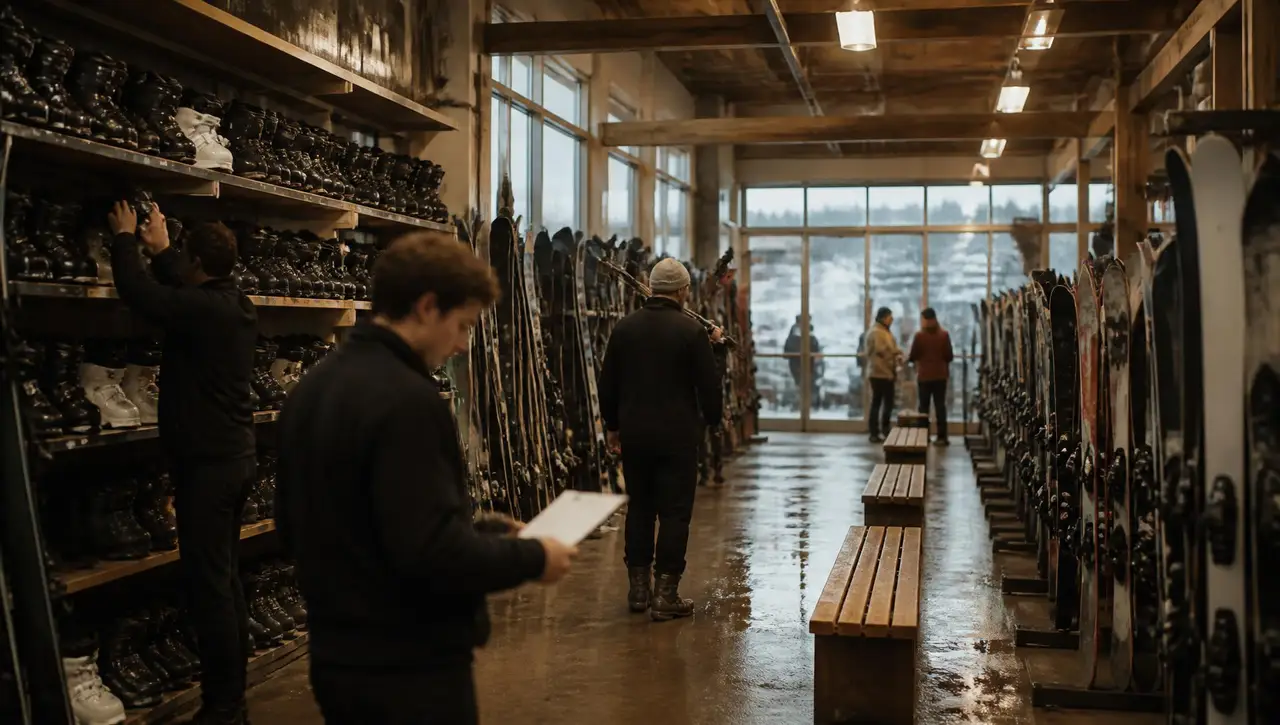
Ski & Snowboard Rentals
Payment Solutions for Ski & Snowboard Rentals
From advance reservations and rental deposits to peak-morning walk-ins and payments across multiple locations, Fizel supports the different ways ski and snowboard rental businesses get paid.
Funding that generally lands the next business day, month-to-month terms with no locked-in contracts, and a merchant account you can pause when the mountain closes.
The commercial shape of a rental operation
The mountain opens at nine. The rental shop starts long before that.
The customer wants to get on the mountain. The rental shop has to get hundreds of details right first, and most of them happen in a room the customer will spend twenty minutes in and never think about again.
One rental can involve an advance reservation, an arrival, an equipment selection, a boot fitting, a deposit or pre-authorization, a payment, a handoff, a return, an inspection and a turnaround for the next customer. At peak, all of that happens repeatedly inside a very compressed window: several hundred times before lunch on a holiday Saturday.
Fizel is the payment layer around that operation, and only that. We do not provide rental inventory systems, reservation software or fleet management, and we would not claim to.
Reserve, arrive, fit, pay, ride, return
Payment can land at several points along one rental.
Where it lands depends entirely on the merchant's setup. The sequence itself is recognisable in almost every shop on the hill.
01
Reserve
Booked online weeks out, often from another country. Payment may be taken in full, as a deposit, or not at all until arrival.
02
Arrive
A family walks in at ten past eight with a booking reference, or with nothing at all. Both are customers.
03
Fit
Boots, skis or a board, helmet, poles. The longest part of the transaction, and the part that has nothing to do with payment.
04
Pay
At the counter, on a wireless terminal in the boot room, or already settled online. Deposits or pre-authorizations may sit alongside it.
05
Ride
The customer is gone for a day or a week. Extra days may be added while they are out there.
06
Return
Equipment comes back, gets checked, gets racked. Any remaining balance or release happens here.
Online during reservation, before arrival, at pickup, through legitimate deposit and pre-authorization workflows, or through added days and other legitimate purchases: Fizel supports the payment moments. The rental itself stays in your own systems.
Sound like your business? Tell us how you take payments today and we'll put together a quote built around it.
Before the doors open
The day starts in the rental room.
It is dark outside and the floor is already wet. Somebody is working down the reservation list, pulling skis and boards and standing them against the wall in name order. Somebody else is sorting boots back into size runs after last night's return rush, because the shells came back in the wrong places and they always do.
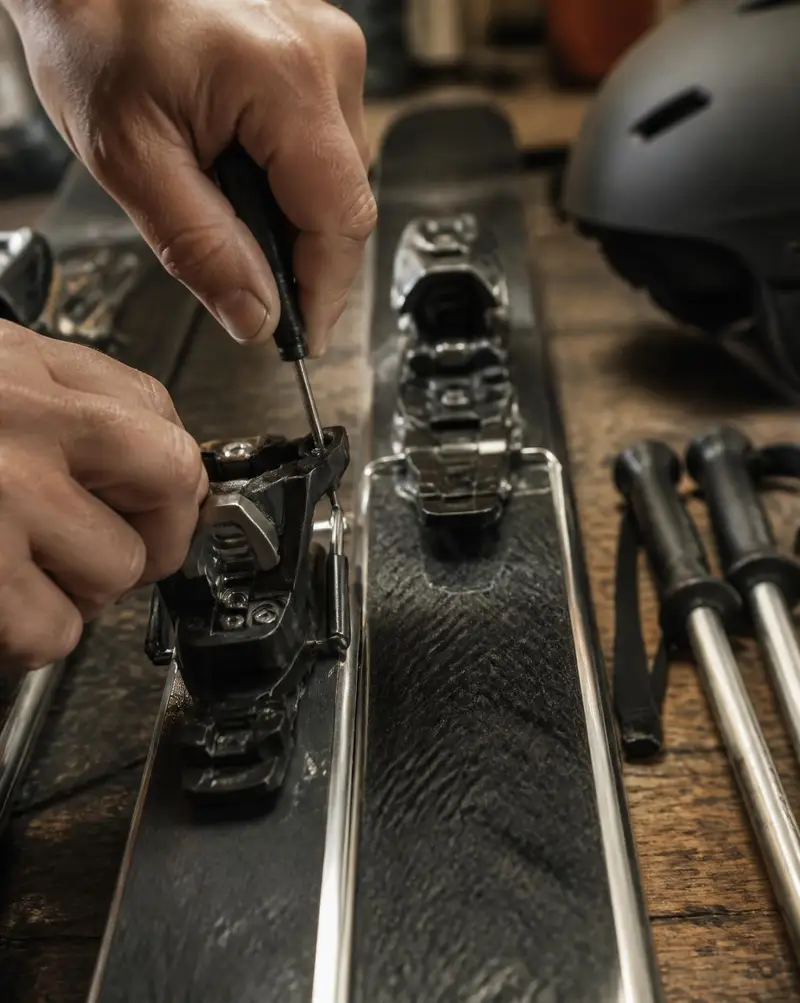
Bindings get checked. Poles get paired. Helmets come out of the bins and go onto the shelf. Where the operation runs electronic devices, they get charged and readied. Fitting benches get cleared. The counter gets set up, the till gets opened, and somebody looks at the day's numbers and works out how many staff need to be on the floor by eight.
None of this is visible to the customer, and all of it decides whether the next four hours work. By the time the first family walks in, the shop has already done half a day.
The mountain opens at nine. The rental shop starts long before that.
Ski and snowboard rentals
Advance reservations
A large share of the season is sold before anyone arrives.
Destination customers plan. They book flights, they book accommodation, and somewhere in that sequence they reserve equipment for four people for six days, weeks or months ahead, from a laptop a long way from the mountain. By the time they walk through the door, the commercial decision was made in October.
Fizel supports that with ecommerce and gateways, hosted payment pages, payment links, deposits and scheduled payments where they genuinely suit the booking. Whether a shop charges in full at reservation, holds a deposit and collects the balance at pickup, or takes nothing until arrival is a merchant policy, and it should be, because it is tied to cancellation terms and to how much of a season a business is willing to hold open.
What Fizel does not manage: inventory allocation, equipment sizing, reservation calendars or rental duration. Those live in your rental and reservation software, where they belong.

Walk-ins
And then there is the customer standing in front of you.
Not every rental is planned. A storm rolls in and people who came for something else decide to ski. A traveller's own equipment never made it off the plane. A family drove up on a whim because the forecast turned. Somebody's plan changed at breakfast.
Countertop terminals, wireless terminals carried out onto the floor and Tap to Pay on supported devices mean the payment can happen wherever the customer is finished: at the bench, at the boot wall, at the door. A shop should be able to serve the person who booked in October and the person who walked in eleven minutes ago with the same competence.
Fitting
The rental is a service interaction, not a handover.
Somebody kneels on a wet floor and works a shell onto a foot. Somebody asks a nine-year-old to stand up and walk four steps. Somebody checks a helmet, pairs poles, and pulls a different length of ski because the first one was not right. It is done hundreds of times a day, mostly by people in their twenties, and done well it is the reason a customer comes back next winter.
We are a payments company, so we will not offer equipment or safety advice: that is your expertise and your liability. The commercial point is simply that the paid transaction wraps around real service time, and the payment step should take the smallest possible share of it.
Deposits and pre-authorizations
You are handing a stranger several thousand dollars of equipment.
Depending on your policies and setup, Fizel supports deposits, pre-authorizations, advance payments and final payments, in person and card-not-present, inside one merchant environment.
We will be precise about what that is worth, because vagueness here helps nobody. A pre-authorization places a hold against a card. It does not guarantee that a merchant can ultimately recover any particular amount for lost, damaged or unreturned equipment, and Fizel does not provide rental insurance or damage-recovery guarantees of any kind.
Hold amounts, damage terms, what counts as normal wear and what happens when a board does not come back are your policies to write and enforce. We supply the payment mechanics; we do not invent the rules and we will not pretend the mechanics do more than they do.
Peak-morning throughput
When everyone arrives at once, the operation has to move.
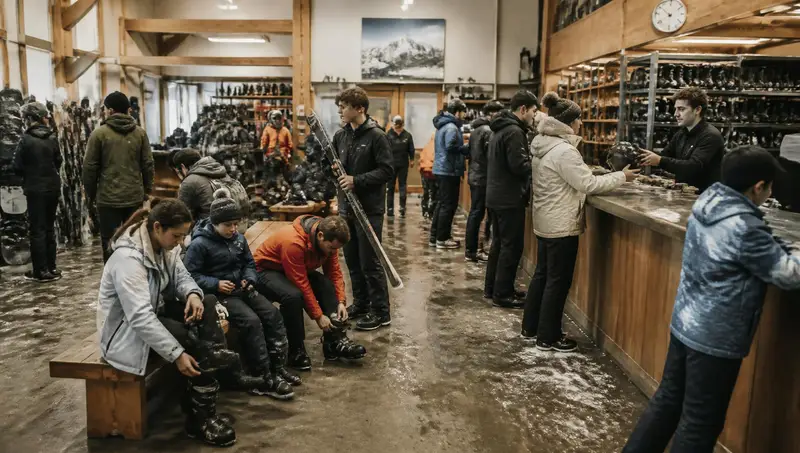
Ski rental demand does not spread itself politely across the day. A holiday Saturday can put a large share of a week's arrivals through the door inside ninety minutes: families of five, reservations to locate, walk-ins to size, returns coming back from yesterday's rental, and someone at the counter buying gloves because they forgot theirs.
The constraint is fitting capacity and floor space, not payments, but payments can absolutely become the extra bottleneck if the environment is wrong. A terminal that has to be walked back to, an online booking that cannot be found, a card the setup will not accept: each one costs a couple of minutes at exactly the moment the shop has none.
Built for the first ninety minutes
Payment should be the fastest part of the rental.
- Wireless terminals that go to the customer, not the other way round
- Tap to Pay on supported devices for extra capacity at peak
- Advance payments already settled before arrival
- Internationally issued cards accepted without drama
- Consolidated reporting across every till and outlet
- Volume spikes expected, because the account was configured for them
Durations, groups and the counter
One day, six days, or five sets of equipment on one card.
Multi-day rentals
A customer may take equipment for an afternoon, a long weekend or a full vacation period, and the duration can change halfway through. Payment may happen in advance, at pickup, or as added days while the customer is somewhere up the mountain. Payment links, a virtual terminal, invoicing where appropriate and in-person acceptance cover all of it. Tracking the rental duration itself stays in your rental software.
Groups and families
One organizer frequently pays for several sets of equipment across multiple days, such as a family of five, a school group or a corporate trip. The transaction value is larger and the arrival is more complicated, and often the person paying is not the person being fitted. Advance payments, payment links, invoicing and in-person payment all apply. Fizel does not provide split-payment or group-management functionality.
Retail and add-ons
Gloves, goggles, socks, wax, a neck warmer for the kid who lost theirs: small practical purchases that ride along with the rental. Countertop and wireless terminals, Tap to Pay, POS and integrations handle them. It is real revenue, but it is not the story of this business, and the account should be built around the fleet rather than the till.
Field note
Every rental has a second half.
Retail ends when the customer leaves. A rental does not. Somewhere out on the hill is inventory that has to come back, be inspected, be dried, be racked and be ready for someone else tomorrow morning, and the business only earns on it while it is moving.
That is the whole operational difference between a shop that sells skis and a shop that rents them, and it shapes everything from staffing to deposits to what the last hour of the day looks like.
Return and turnaround
One rental ends. The next one is already waiting.
From mid-afternoon the flow reverses. Skis and boards come back wet and cold and get stood in the return racks. Boots come off and go back onto shelves. Equipment is looked over, edges and bases checked, anything damaged pulled aside. Helmets get wiped down. What can go back out tomorrow gets sorted into tomorrow's pile.
On a peak weekend this happens continuously, overlapping with the customers still being fitted for the next morning. It is unglamorous and it is the reason the fleet earns anything at all.
The payment side of it is narrow and specific: releasing or settling holds, taking a balance for extra days, handling a legitimate charge under your own damage policy. Fizel does not manage equipment turnaround, inspection or maintenance, and no payment provider should tell you it does.
Destination customers and the season
A year of revenue can arrive inside a few months.
Ski destinations draw travellers, and a good share of them book and pay before they enter the country or the province. Fizel supports internationally issued cards, multiple currencies and FX/DCC where relevant, alongside advance online payments, so a reservation from overseas is an ordinary transaction rather than an exception.
Depending on where you are, the business may run around opening day, holiday periods, mid-winter peak, powder and weather cycles, spring skiing and closing day. We are not going to impose one universal ski season on operations spread from Quebec to interior British Columbia to the Rockies. The commercial reality is what they share: a significant portion of annual revenue may arrive within a relatively short winter operating season, and the account has to be sized for that rather than for an average month.
Seasonal terms
Off-season? Pause your merchant account until the mountain opens again.
No paying to keep a dormant account alive through the months the shop is shut and the fleet is in storage.
- Seasonal merchant-account pausing through the off-season
- Month-to-month, no locked-in contracts
- Funding generally next business day
- Winter volume spikes expected, not flagged as unusual
- Pricing quoted against your season, not a flat annual average
One shop or a whole destination
An independent in a mountain town, or a resort operation with several outlets.
A six-person shop on a main street and a resort rental business running village, base-area and hotel locations are the same problem at different scale: get the right equipment to the right customer quickly, repeatedly, through a short season.
Fizel supports multi-location payment environments, consistent acceptance across sites, consolidated reporting and centralized visibility. Fleet inventory across locations is not ours to manage: that stays in your rental software.
Existing systems and integrations
Keep the systems that already work.
Most rental businesses already run rental-management software, a reservation platform, resort systems, POS, ecommerce, inventory and accounting. Replacing that stack in October is nobody's idea of an improvement.
Fizel integrates broadly across commerce and business systems. We start with how the operation runs today and build the payment environment around it; the specific integration for your stack is confirmed during setup rather than promised in a brochure. Fizel did not build and does not own rental, reservation, resort or inventory software.
Capabilities, by moment
What the payment layer actually has to do.
Before arrival
The booking that happens from a laptop in another time zone.
- Ecommerce and gateways
- Hosted payment pages
- Payment links
- Deposits
At pickup
The counter, the boot room and the line behind it.
- Countertop terminals
- Wireless terminals
- Tap to Pay on supported devices
- Deposits and pre-authorizations
Remote and extensions
Another two days, and nobody is coming back to the shop.
- Payment links
- Virtual terminal
- Invoicing where appropriate
- Card-not-present acceptance
Across the operation
One shop or eight outlets across a destination.
- Merchant accounts
- Internationally issued cards, multiple currencies, FX/DCC
- Multi-location environments
- Consolidated reporting and broad integrations
Who this is for
Ski and snowboard rental operations across Canada and the United States.
Different sizes, one shared reality: a fleet that has to go out and come back, over and over, inside a short winter.
Ski rental shops
Independent operations in a mountain town, running a fleet through a short, intense season.
Snowboard rental shops
Boards, boots and helmets, often with a demo side and a younger, walk-in-heavy customer base.
Resort rental operations
Base-area outlets sized for the first hour of a holiday Saturday.
Destination rental businesses
Customers who reserve before they book flights and arrive with a confirmation on a phone.
Demo and rental centres
Higher-value equipment, shorter durations, more frequent swaps through the day.
Multi-location operators
Village, base area, hotel outlets and several stores across a destination under one business.
Shops whose business is retail, fitting, tuning and seasonal inventory should start with ski & snowboard shops. Operations renting a broader mix of gear across more than one season will find outdoor equipment rentals a closer fit, and resorts selling lift access and on-mountain operations belong on ski resorts.

Everything in the rental room leads here.
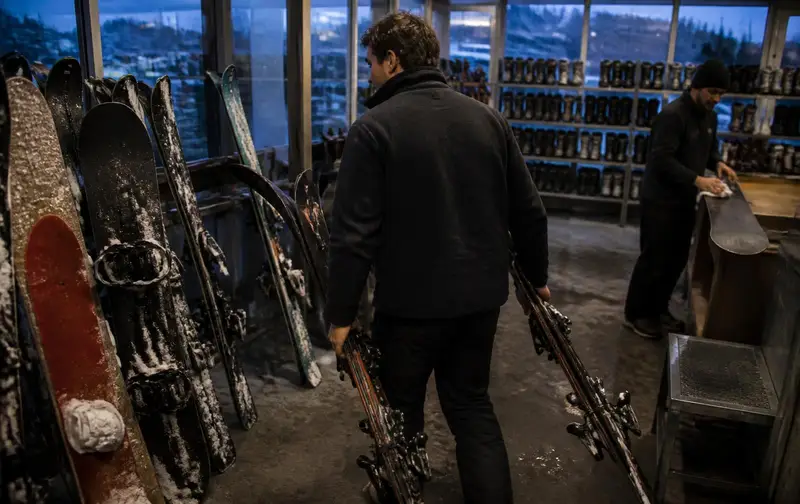
Two of the several hundred people the shop fitted this morning.
Settlement, terms and support
Nobody with a line out the door should be explaining seasonality to a support queue.
A rental operator mid-holiday-weekend, hundreds of reservations, every fitting bench full, returns stacking up at the back door, does not have time to explain from first principles why its volume looks the way it does. Why a quiet November turned into a vertical December. Why one Saturday did more than the three weeks before it.
Fizel provides knowledgeable human payments support from people who understand seasonal rental businesses. Funding generally arrives the next business day, terms are month-to-month with no locked-in contracts, and seasonal accounts can be paused in the off-season. We do not publish response-time guarantees or SLAs, because we would rather be judged on the conversation than on a number.
Background reading: payment processing for equipment rentals and payment processing for ski resorts. Transparent pricing is set out on our pricing page.
How Fizel fits
- Morning rush
- Terminals move a line of families out the door before first chair.
- Booked online
- Prepaid rentals and deposits taken through hosted checkout the night before.
- Gear holds
- Pre-authorized holds on skis and boards, released when the gear is returned.
- Season leases
- Scheduled payments cover season-long junior and adult lease programs.
Questions rental operators ask
Reservations, deposits, walk-ins, software, locations and the off-season.
Can Fizel support online reservations and advance payments for ski and snowboard rentals?
Yes. Destination customers routinely reserve equipment weeks before they arrive, and Fizel supports the payment side of that: ecommerce and gateways, hosted payment pages, payment links, deposits and scheduled payments where they genuinely suit the booking. A shop can take payment in full at the time of reservation, take a deposit and collect the balance at pickup, or take nothing until the customer is standing in front of them: that is a merchant decision, not ours. What Fizel does not do is manage the reservation itself. Inventory allocation, sizing, availability calendars and rental duration belong to your rental or reservation software; Fizel is the payment layer around it.
Can we use deposits or pre-authorizations for rental equipment?
Yes. Depending on your policies and how the account is configured, Fizel supports deposits, pre-authorizations, advance payments and final payments, in person and card-not-present. Being precise about what that means matters: a pre-authorization places a hold against a card, but it does not guarantee that a merchant can ultimately recover any particular amount for lost, damaged or unreturned equipment, and Fizel does not provide rental insurance or any form of damage-recovery guarantee. Deposit amounts, hold policies, damage terms and what happens when equipment does not come back are yours to set and enforce. We support the payment mechanics behind them.
Can Fizel support both advance reservations and walk-in rentals?
That combination is the normal state of a ski rental operation, and the account should be built for both from the start. Advance reservations run through ecommerce, gateways, hosted payment pages and payment links. Walk-ins run through countertop terminals, wireless terminals carried into the boot room and Tap to Pay on supported devices. Weather moves demand between the two without warning: a storm cycle fills the shop with people who had no intention of renting, and a warm week turns confirmed bookings into questions at the counter. Both paths sit inside one merchant environment with consolidated reporting, so the business is not reconciling two separate worlds at the end of a peak weekend.
Can Fizel work with our existing rental or reservation software?
That is where we start. Ski and snowboard rental businesses commonly run rental-management software, a reservation platform, resort systems, a POS at the counter, ecommerce, an inventory system and accounting that everything reconciles into. Fizel does not build, own or replace any of it, and has no rental, reservation or inventory product of its own. We integrate broadly across commerce and business systems, begin with how your operation actually runs today, and confirm the specific integration for your stack during setup rather than naming platforms in advance. Keep the systems that already work; we improve the payment environment around them.
Can Fizel support multiple rental locations?
Yes. A village shop, a base-area outlet, a hotel location and two more stores across the destination can run consistent payment acceptance with consolidated reporting and centralized visibility, whether that is two locations or a resort operation with outlets in several places. Each site can keep the acceptance mix that suits it (heavy in-person terminal volume at the base, more advance ecommerce at the flagship) while the business sees one coherent picture of what came in and where. Fizel does not manage rental fleet inventory across locations; equipment allocation stays in your rental software.
Can seasonal ski rental businesses pause their merchant account during the off-season?
Yes, and off-season is exactly when to do it: pause your merchant account until the mountain opens again. Ski and snowboard rentals are among the most seasonal businesses we serve, and a significant portion of annual revenue can arrive inside a relatively short winter operating season. Terms are month-to-month with no locked-in contracts, funding generally arrives the next business day, and genuinely seasonal accounts can be paused through the months when the shop is shut rather than paying to keep a dormant account alive. We describe next-business-day funding as the general case rather than an unconditional guarantee, because banking calendars, timing and individual account configuration all play a part.
Next step
Tell us what your peak Saturday looks like.
How much of the season is booked in advance, how you handle deposits, how many locations you run and when your winter actually starts and ends is usually enough to size the account correctly.