
Ski Resorts & Mountain Resorts
Payment Solutions for
Ski Resorts & Mountain Resorts
One mountain. Many ways to pay. A single guest can buy a lift ticket online in November, rent skis at eight, check into a lesson at nine, eat at the day lodge, buy goggles in the afternoon and settle a lodging balance before leaving.
Fizel builds one payment environment across every department of a resort, with funding that generally lands the next business day and month-to-month terms that respect how a mountain season actually behaves.
The business behind the mountain
One mountain. Many ways to pay.
A ski resort is not one merchant environment. It is a ticket office, a rental shop, a school, a retailer, a restaurant group and, for many properties, a lodging business, all operating on the same acreage on the same morning. The guest experiences one place. The finance office reconciles six.
The complexity is not only in the number of counters. It is in the timing. A season pass is paid for in September and delivered from December to April. A lodging deposit is taken in October and settled at check-out. A rental is pre-authorized in the morning and released in the afternoon. A hoodie is a fifteen-second tap. All of it is the same business, and all of it should report as one.
Fizel works exclusively with businesses built around the outdoors. Mountain operations sit inside Resorts & Destinations, and they are the most demanding payment environment in the category: multi-department, multi-channel, seasonal and, for many properties, multi-site.
Tickets & passes
Day tickets at the window, season passes sold months before the lifts turn, advance online purchases, renewals and add-on products: the highest-value and earliest revenue on the mountain.
Rentals
Ski and snowboard packages moving through a counter in waves, with deposits, pre-authorizations where appropriate, and reservations taken online days before the guest arrives.
Lessons & programs
Ski and snowboard school, private lessons, group clinics and multi-day or multi-week programs, usually sold in advance, often with a deposit and a balance.
Retail
Resort shops selling goggles, gloves and apparel alongside genuinely high-ticket hardgoods. Two orders of magnitude between the smallest and largest sale at the same counter.
Food & beverage
Cafeterias, quick-service windows, sit-down restaurants and bars, all compressed into the same two-hour lunch peak that fills the base lodge.
Lodging & events
Where you operate it: reservations, deposits and balances. Plus races, festivals, corporate groups and the summer operations that increasingly run alongside them.
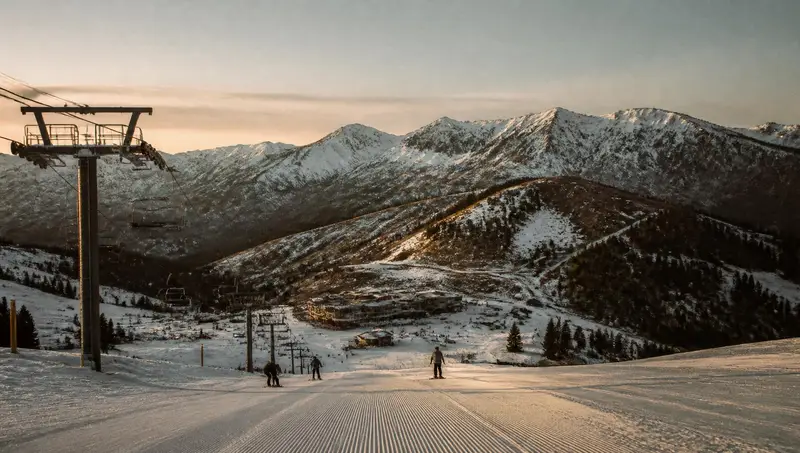
By the time the first guest arrives, the mountain has already been open for hours.
Tickets, passes & advance sales
Most of the season is sold before it starts.

Season passes, early-bird pricing, renewals, advance day tickets and preseason lodging and program bookings all move money into the business long before the product is delivered. That preseason window is the single most important commercial period a mountain operation has, and it happens almost entirely online.
Fizel supports ecommerce payments, gateways and hosted payment pages for pass and ticket sales, payment links for deposits and balances, and recurring or scheduled payments for pass installment plans and memberships. Renewals bill on the schedule you set. Day tickets bought at the window run on the same account as tickets bought from a phone in a parking lot, and both land in the same reporting.
When a pass sale surges over a single weekend, funding that generally arrives the next business day puts working capital back into snowmaking, hiring and preseason preparation while the decisions still matter.
Season passes now account for about half of US skier visits. For the visit, pass and snowfall data behind that shift, see Ski Industry Statistics 2026.
Sound like your business? Tell us how you take payments today and we'll put together a quote built around it.
Rentals, school & programs
The two counters that decide the morning.
Rental and ski school are where a resort's first-time and destination guests are made or lost, and both carry payment behaviour that ordinary retail never sees.

Rentals are reserved online, paid at the counter, extended by a day, damaged occasionally and returned in a rush at four o'clock. Deposits and pre-authorizations hold value against equipment without turning the counter into an argument, and online reservations mean the transaction is largely complete before the guest reaches the boot bench. Where demand spikes, wireless terminals and Tap to Pay on supported devices open a second line without building a second counter.

Lessons and programs are sold on a different clock. A private lesson is booked the night before; a multi-week junior program is registered and paid in October; a group booking arrives as a deposit, an invoice to a school or corporate organizer, and a balance on the morning of arrival. Payment links, invoicing, the virtual terminal and scheduled payments cover all of it without sending families back to a ticket window.
Retail, food and everything on the hill
Small taps and large tickets, sixty seconds apart.
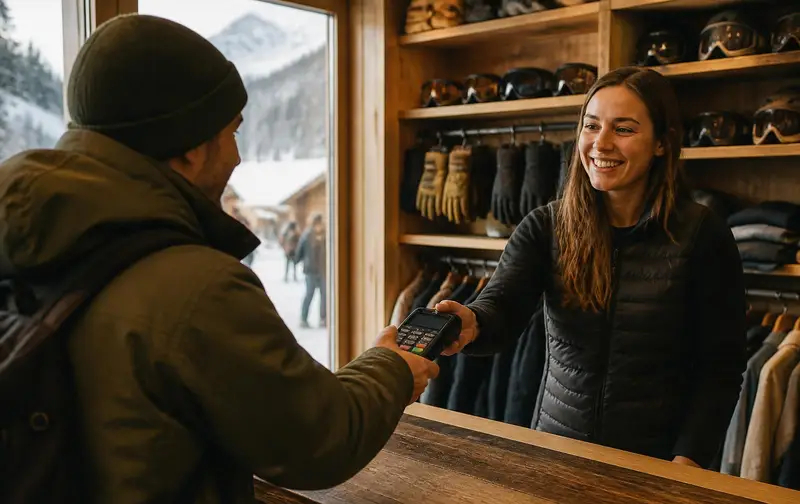
A resort shop sells a four-dollar wax rub and a two-thousand-dollar ski package at the same register. Food and beverage compresses a day's transactions into a lunch hour across a cafeteria, a quick-service window, a sit-down restaurant and a bar. None of these outlets can afford a slow terminal or a declined higher-ticket sale on the busiest Saturday of the year.
The account is configured for your real transaction profile: the mix of ticket sizes, the volume spikes, the seasonal ramp, rather than an average that no resort actually experiences. Where you also sell online, that channel runs on the same merchant account as the base lodge, so a hoodie bought from a chairlift and a hoodie bought at the counter reconcile together.
Operating reality of a mountain resort
6+
Departments running under one roof: tickets, rentals, school, retail, food and, often, lodging.
0
Control over the weather that decides whether a weekend is the busiest or quietest of the season.
Months
Ahead of the season that a pass or a lodging deposit is collected before a single lift turns.
The resort cash cycle
A year that arrives in bursts.
Almost no other business has a cash cycle shaped like a mountain's: revenue collected months early, delivered in compressed weekends, and dependent on weather nobody can forecast far enough ahead.
- 01
Season pass sales
A concentrated preseason window that can move a substantial share of the year's revenue before a single chair spins.
- 02
Preseason deposits & bookings
Lodging deposits, program registrations, group bookings and rental reservations collected long before the product is delivered.
- 03
Opening weekend
Volume switches on all at once. Ticket windows, rental counters, retail and food all go live on the same morning.
- 04
Holiday peaks
The heaviest days of the year, with every terminal on the property working simultaneously and no margin for a payment problem.
- 05
Weather-dependent weekends
A storm cycle and a green weekend are different businesses. Volume concentrates into compressed, unpredictable windows.
- 06
Spring & summer operations
The slowdown, then, for four-season properties, bike park, sightseeing, weddings, festivals and camps carrying the property through.
Two commercial points matter more on a mountain than almost anywhere else. Funding generally lands the next business day, so a holiday week or a powder weekend cycles back into payroll, grooming, snowmaking and inventory quickly rather than sitting in transit. And Fizel is month-to-month with no locked-in contracts, which is the honest arrangement for an operation that runs at full capacity for a handful of weeks and near-idle for others.
Field note
The mountain opens hours before the guests do.
Patrol is doing avalanche control before dawn. Groomers are finishing the last run of corduroy as the sky goes from black to grey. Lift crews are checking towers and loading chairs while the parking lot is still empty. None of this is visible to the first guest in line at the ticket window; to them, the mountain simply appears ready.
It is a business that spends most of its working hours preparing for a few hours of guest-facing operation, on a schedule set entirely by snow, wind and light.
Payment capabilities
Enterprise capability, configured for a mountain.
Most resorts use a subset of these. What matters is that tickets, rentals, school, retail, food and lodging behave consistently and report in one place.
Across the mountain
- Countertop terminals for ticket windows, rental counters, retail and F&B
- Wireless and mobile terminals for base-area tills, events and seasonal outlets
- Tap to Pay on supported devices for pop-up sales points and race registration
- POS integrations across departments on one merchant relationship
Before the guest arrives
- Ecommerce payments, gateways and hosted payment pages for passes and tickets
- Payment links for deposits, program balances and group bookings
- Recurring and scheduled payments for pass installment plans and memberships
- Invoicing and virtual terminal for corporate groups, race organizers and schools
Complex and higher-value
- Deposits and pre-authorizations for rentals and lodging
- High-ticket transactions for hardgoods, multi-pass and group purchases
- Internationally issued cards, multiple currencies and FX/DCC
- Multi-department and multi-property environments with consolidated reporting
A fuller view of what Fizel builds, in person, online and everywhere in between, sits on the solutions page.
Systems, reporting & support
Start with how the resort already operates.
A working resort already runs ticketing and pass management, reservations, rental software, retail POS, food and beverage systems, an ecommerce storefront and an accounting package. Fizel integrates broadly across those categories and builds the payment layer underneath them. Nothing about a payments change should require a resort to rebuild the systems its staff learned last season; the specific integration for your stack is confirmed during setup.
See the platforms Fizel works with for a sense of the ecommerce, POS, accounting and business systems payments can connect to.
Multi-department and multi-property environments are ordinary here. A single mountain with eight outlets, or an operator running several hills and a Nordic center, can work as one payment environment with consolidated reporting while each department and each property keeps its own view of the day. That is what lets a finance office close a holiday week without chasing six statements from four providers.
And when something needs sorting at nine in the morning on a holiday Saturday, with ticket windows queued, rental counters full and the lodge filling, you reach knowledgeable payments people who already understand ticket sales, deposits, pre-authorizations, multi-outlet terminals and seasonal volume. Not a queue that needs the business explained to it first.
How Fizel fits
- Tickets & passes
- Hosted checkout sells day tickets and season passes long before the snow flies.
- Season pass plans
- Scheduled payments spread a pass across the autumn instead of one payment.
- On-mountain outlets
- Food, retail, rental and lesson desks process under one account with reporting by outlet.
- Peak-day volume
- A holiday weekend is a volume spike, not an anomaly, with next-business-day settlement.
Pricing
Quoted on the whole property, not one counter.
A resort is a materially more complex payment environment than a single merchant. Pricing should reflect your volume and seasonal shape, transaction mix, online and in-person split, deposits and recurring billing, number of outlets and properties, international guest share and the systems already in place. Month-to-month, with no locked-in contracts.
Further reading
Payment Processing for Ski Resorts & Nordic Centres
How mountain operations handle pass sales, rental deposits, multi-outlet acceptance and a season that pays for itself in bursts.
Read the guideQuestions
Resort payments, answered.
Can one merchant relationship cover tickets, rentals, lessons, retail, food and lodging?
Yes. Ticket windows, rental counters, ski school, resort shops, food and beverage outlets and, where you run it, lodging can all sit inside one payment environment, with each department keeping its own view of the day and finance seeing consolidated reporting across the property. That is the point of working with a payments partner instead of assembling four unrelated processing relationships across one mountain.
How do season passes and advance sales work?
Season passes are usually sold online, months before the lifts turn. Fizel supports ecommerce payments, gateways and hosted payment pages for pass and ticket sales, plus recurring and scheduled payments for pass installment plans where you offer them. Renewals can be billed on the schedule you set, and preseason volume reports alongside in-season volume rather than sitting in a separate system.
Can we take deposits and pre-authorizations on rentals and lodging?
Yes. Deposits and pre-authorizations are supported and are configured for how your operation actually uses them: a hold on rental equipment, a deposit at the time of a lodging reservation, a balance collected at arrival or departure, or an advance payment for a multi-day program.
Do we have to replace our ticketing, rental or POS systems?
No. Fizel starts with how the resort already operates. We integrate broadly across ticketing and pass-management systems, reservation and rental platforms, retail POS, food and beverage systems, ecommerce and accounting software. The specific integration for your stack is confirmed during setup. Fizel is your payments partner, not your resort software vendor.
We're a destination resort with international guests. Is that a problem?
No, it is expected. Internationally issued cards, multiple currencies and FX/DCC are all supported, and the account is configured from the start for a guest mix that includes out-of-country visitors and higher-ticket purchases rather than treating them as exceptions.
How quickly are we funded, and are we locked into a contract?
Funding generally lands the next business day, which matters when a holiday week or a storm weekend concentrates a large share of the season into a few days of payroll, grooming and inventory. Fizel works month-to-month with no locked-in contracts, a fair arrangement for an operation whose December looks nothing like its April.
Something specific to your property? Contact us and we will give you a straight answer. For destination outdoor properties built around lodging and nature-based experiences rather than mountain operations, see eco & wilderness resorts. Or see the rest of the industries we serve.
Ready before the lifts turn.
Tell us how your mountain takes money today: passes, tickets, rentals, school, retail, food, lodging and everything the summer adds, and we will build a quote around the whole property.
Running numbers before the season? Our free statement analysis reads a recent statement and shows your effective rate across tickets, rentals, retail and food outlets.