

Outdoor Equipment Rentals
Payment Processing for
Outdoor Equipment Rentals
The payment happens, the equipment leaves, and then it comes back. Almost nothing else in the outdoor economy works that way, and most payment setups are built for transactions that end at the counter.
Fizel sets payments up for the whole rental cycle: the booking, the hold, the pickup, the extension and the return.

Inventory only earns while it is moving.
The merchant reality
Every board on the rack is capital sitting still.
A rental business owns its revenue. Every board, bike, boot, harness and paddle on the rack is capital sitting still, and it only pays for itself in the hours it is out with a customer. That puts a peculiar kind of pressure on the payment counter: whatever happens there cannot be the reason a family of four is still standing inside at half past nine on the best morning of the summer.
And unlike a retail sale, the transaction is not finished when they leave. It stays open, through the extension, the upgrade and the return, sometimes for an afternoon, sometimes for a week.
Outdoor equipment rentals sit inside the wider Rentals category Fizel works across. Shops that rent tents, packs and climbing hardware alongside what they sell will also want our payment processing for climbing, hiking and camping shops page.
How the money actually arrives
One rental. Four places a payment can land.
Few rentals are a single tap. The same customer can pay before they arrive, again at pickup, again while the gear is out, and once more on the way back in.
- 01
Before
A reservation comes in from a phone, three provinces away, at eleven at night. Sometimes it is paid in full, sometimes it is a deposit holding a board, a bike or four sets of skis for a Saturday.
- 02
At pickup
The balance is taken at the counter, along with a hold on higher-value equipment where that makes sense. This is also where the group grows by two people and the half day becomes a full day.
- 03
While it is out
An upgrade, an extra day, a second paddle, a roof rack. The customer is no longer standing in front of you, so the charge has to reach them wherever they are.
- 04
At return
The hold is released or settled, anything legitimately owed is squared up, and the gear goes back on the rack, ideally in time to go out again the same afternoon.
Sound like your business? Tell us how you take payments today and we'll put together a quote built around it.

Deposits and holds
Equipment worth thousands leaves with someone you met four minutes ago.
Two different tools get used here, and they are worth keeping straight. A deposit takes money now to hold a reservation and is applied against the rental. A pre-authorization places a temporary hold on the customer's available funds, to be released or captured later.
Both can be set up on your account, and both are commercial tools rather than guarantees, a hold sits alongside your rental agreement and your judgement at the counter, not in place of them. The practical goal is a hold large enough to be meaningful on a carbon bike or a touring kit, handled quickly enough that it does not become the awkward part of the handover.
Payment capabilities
Booked online, paid at the counter, settled on return.
Most operators use some of these, not all of them. What matters is that a deposit, a balance, an extension and a retail sale behave consistently and reconcile in one place.
Before they arrive
- Ecommerce payments and gateways for online reservations
- Hosted payment pages for deposits
- Payment links for balances, extensions and add-ons
- Virtual terminal for bookings taken over the phone
At the counter
- Countertop terminals sized for a queue, not a quiet shop
- Pre-authorizations and holds on higher-value equipment
- Rentals, accessories and retail on one merchant account
- Internationally issued cards, multiple currencies and DCC where you serve visitors
Away from the counter
- Wireless terminals and Tap to Pay on supported devices
- Invoicing for schools, clubs, tour operators and corporate groups
- Scheduled payments where longer or seasonal rentals are paid in stages
- Multi-location setups reporting into one place
The full range is on our solutions page. Online reservations, deposits and pre-authorizations are covered under selling online.

Where the handover happens
The counter is not always a counter.
Plenty of rental businesses hand equipment over somewhere other than a shop: a dock, a beach, a trailhead, a resort base, a seasonal container, a van at the bottom of a run. Wireless terminals and Tap to Pay on supported devices let staff take a balance, an add-on or an extension at the point the gear actually changes hands.
Fizel gives you two ways to take that payment: wireless terminals and Tap to Pay in person at the point of handover, and payment links when the payment needs to be taken remotely. Where a location has patchy cellular or Wi-Fi coverage, that is a planning question (which method fits that site) not a reason the payment cannot get taken.
Start with what you already run
Fizel is not rental software.
By the time an operator talks to us there is usually a reservation system holding the calendar, a POS on the counter, inventory tracked down to the serial number, waivers collected somewhere, and a bookkeeper who knows exactly how the season is supposed to close.
See the platforms Fizel works with for a sense of the ecommerce, POS, accounting and business systems payments can connect to.
We do not open by asking you to replace any of it. Fizel integrates broadly across rental, reservation, POS and accounting systems, and the aim is to keep what already books the rental, checks the gear out and records the sale, we review your setup and confirm the right integration for it. There is no locked-in contract to worry about while you find out: Fizel runs month-to-month.
Where the cycle closes
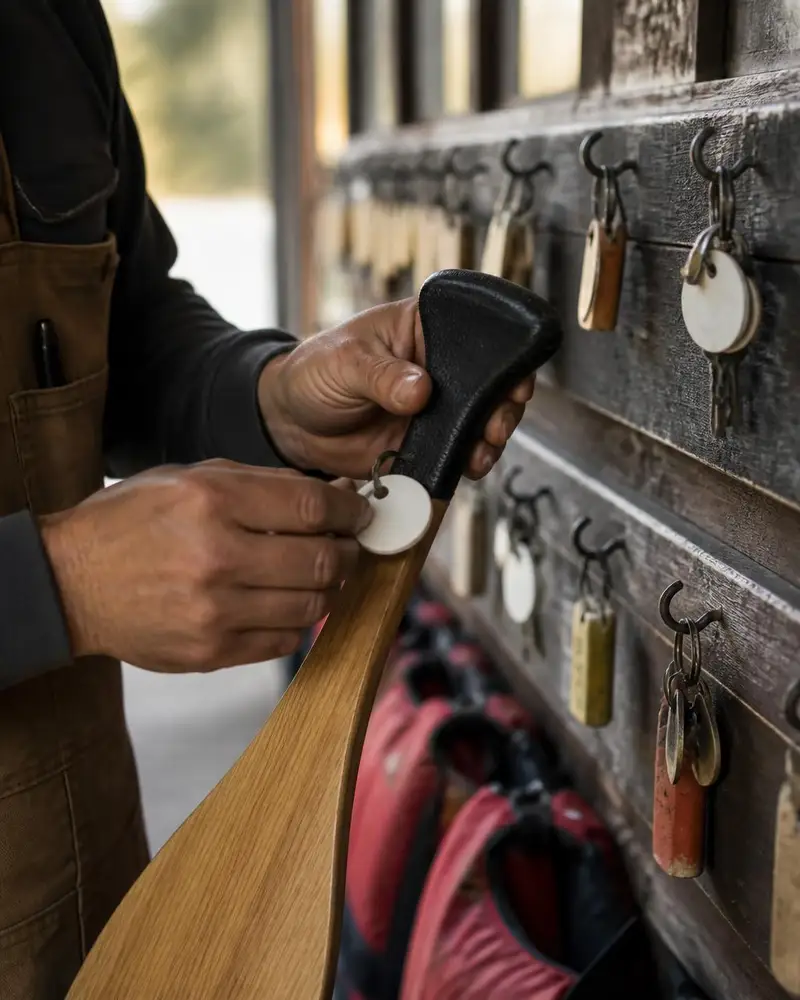
A paddle tagged, a hold released, the rack reset.
The return is where a rental actually finishes, not when the customer walks out with the gear, but when it comes back, gets checked, and the hold on their card is either released or settled for what was legitimately owed.
Done quickly and cleanly, that moment is forgettable. Done slowly, it is the last impression of the rental, and the gear sits idle a few minutes longer before it can go out again.
What makes this different
A year's revenue inside a handful of weekends.
Rental demand rarely spreads itself evenly. A summer paddle operation can do a disproportionate share of its year between two long weekends; a mountain rental shop can live or die on school holidays and a good snow year. When the season is compressed, an hour lost to a slow counter on a peak Saturday is not recoverable in October, and with settlement generally landing the next business day, a record Saturday turns into working capital at the start of the following week, not weeks later when the season has already moved on. On that same Saturday, support that actually knows rental payments, deposits, holds, a queue out the door, matters more than it does on a quiet Tuesday in March.
It is worth describing that shape honestly at the outset, the quiet months, the shoulder season and the visitors who pay on cards issued in another country. Internationally issued cards, multiple currencies and DCC are part of a standard Fizel setup for rental operations serving visitors, not an exception handled after the fact.
Field note
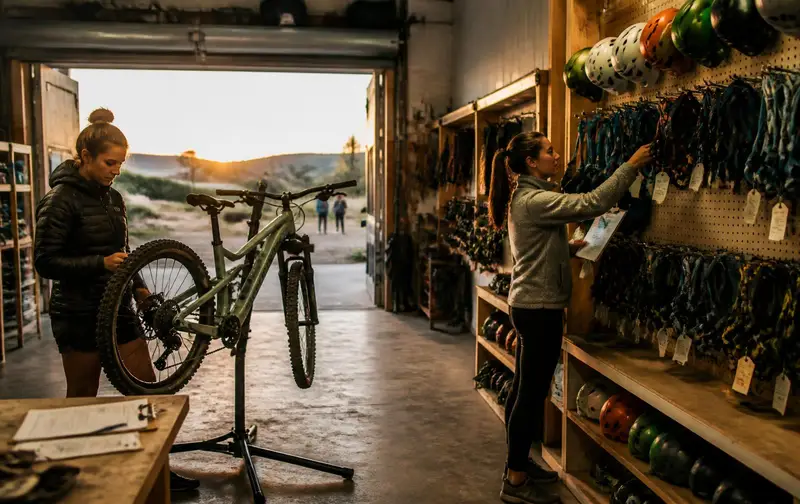
The reset happens before the shop opens.
By the time the first customer of the day walks in, the fleet has usually already turned over once, boards hosed down, bindings checked, boots dried on racks overnight, everything back where a crew member expects to find it at seven the next morning.
Turnover days, the ones between a shoulder season and the next rush, are when that crew earns its keep: cleaning, repairing and re-tagging gear that will not get a second look once the season properly starts. It is unglamorous work, and it is the reason the rack is ready every single morning it needs to be.
How Fizel fits
- Counter turnaround
- Terminals keep the pickup line moving when a whole family is being fitted at once.
- Reserved ahead
- Online deposits commit the gear before the customer arrives.
- Damage holds
- Pre-authorize a hold on the gear and release it when everything comes back.
- Delivery & drop-off
- Mobile acceptance for gear delivered to a cabin, dock or trailhead.
Pricing
Priced on your rental mix, not a flat average.
A hundred-dollar half-day paddle rental and a multi-day equipment package price differently, and an operation taking most of its money online looks different again from one taking it at a counter. Rather than publishing a rate that will not match your business, we quote on your real volume, ticket sizes and mix.
Further reading
Payment Processing for Equipment Rental Businesses
The longer guide: deposits, holds, online reservations and counter workflows, and what to compare when you are choosing a payments partner for a rental operation.
Read the guideQuestions
Rental payments, answered.
Can we keep the rental and reservation software we already use?
Yes. Fizel integrates broadly across rental and reservation software, POS, waiver tools and accounting packages, and the goal is to keep what you already run rather than replace it. We review your specific setup with you and confirm the right integration for it, and Fizel runs month-to-month, with no locked-in contract either way.
What is the difference between a deposit and a pre-authorization?
A deposit is money actually taken, usually to hold a reservation, and applied against the rental. A pre-authorization places a temporary hold on available funds on the customer's card, which can later be released or captured in part or in full. A hold is a useful tool for higher-value equipment, but it is not a guarantee that any particular amount can be collected, and it should sit alongside your rental agreement rather than replace it.
Customers book online and pick up in person. Does that need two providers?
No. Online and in-person payments can run under one merchant relationship with reporting in one place, so a deposit taken on the website and a balance taken at the counter belong to the same transaction rather than two separate systems. How tightly your website and rental software talk to each other beyond payments depends on the platforms involved.
We rent from a beach, a trailhead or a temporary location. What works there?
Wireless terminals and Tap to Pay let staff take payment wherever the gear is handed over, with payment links covering anything taken remotely. Coverage at a beach or trailhead is something we plan around with you upfront, choosing the right method for that site rather than treating it as a gap.
We rent gear and also sell accessories. Can both run on one account?
Yes. Rentals, add-ons, consumables and retail merchandise can sit on the same merchant account and reconcile together, which matters when a single customer walks out with a rented board, a leash they bought and a two-day extension on the way.
Our season is short and intense. Is that a problem?
Seasonal patterns are normal across the outdoor economy and accounts can be set up expecting them. It is worth describing your real shape at the outset (a twelve-week summer, two winter school holidays, a handful of enormous weekends) so that a busy month reads as your season rather than as something unexpected.
Something specific to your operation? Contact us and we will give you a straight answer.
Built for gear that goes out and comes back.
Tell us how your rentals are booked, picked up and returned today, and we will put together a quote around it.