

Powersports
Payment Processing for
ATV & UTV Dealers
One buyer is a rancher putting a work order and a lender's financing paperwork through the counter. The next is a weekend rider leaving a deposit on a side-by-side, or a contractor's purchase order for a fleet of units with plows attached before they leave the lot. Parts, attachments and a service bay running every month of the year sit underneath all of it.
Fizel brings those payment environments together, with settlement that generally lands the next business day and month-to-month terms.
The dealership reality
One lot, two very different buyers.
A rancher signs a purchase order for a UTV with a winch and a cab enclosure fitted before delivery. A contractor's fleet account gets invoiced on terms. A weekend rider puts down a deposit on a side-by-side and finances the balance through a lender. All three are normal transactions at an ATV and UTV dealership, and none of them pay the same way.
Most payment setups assume one kind of buyer. A dealership that serves farms, ranches, contractors and municipalities alongside recreational riders needs account billing, purchase order workflows and consumer card acceptance running under the same roof, plus a service department, parts counter and online orders on top of that.
Fizel specializes in the outdoor economy and works across the wider Powersports category, from powersports dealers to RV and powersports rentals.
Retail counter. Fleet account. Service bay.
Four kinds of payment, one dealership.
A recreational buyer at the counter and a municipality on a purchase order do not pay the same way, and neither should have to fit the other's workflow. Fizel treats both as ordinary business.
Unit sales & deposits
Deposits on new and used ATVs, UTVs and side-by-sides, plus the balance collected when the unit is prepped and handed over, whether a customer is paying outright or a lender is funding the rest.
Work orders & fleet accounts
Purchase orders from farms, ranches, contractors and municipalities, invoiced and paid on the account customer's terms rather than a walk-in transaction.
Parts & attachments
Tires, winches, plow blades and cab enclosures. Some ring through at the counter, some go out attached to a unit before it ever leaves the yard.
Service, year round
A shop that runs through every season, from pre-season inspections to winter plow repairs, quoted, approved and paid at pickup or ahead of time.
Work & play
farms, ranches, contractors and municipalities buying alongside recreational riders
Daily
parts, attachment and service payments running underneath every unit sale
Most of the year
demand spread across seasons rather than concentrated in one narrow window
Sound like your business? Tell us how you take payments today and we'll put together a quote built around it.
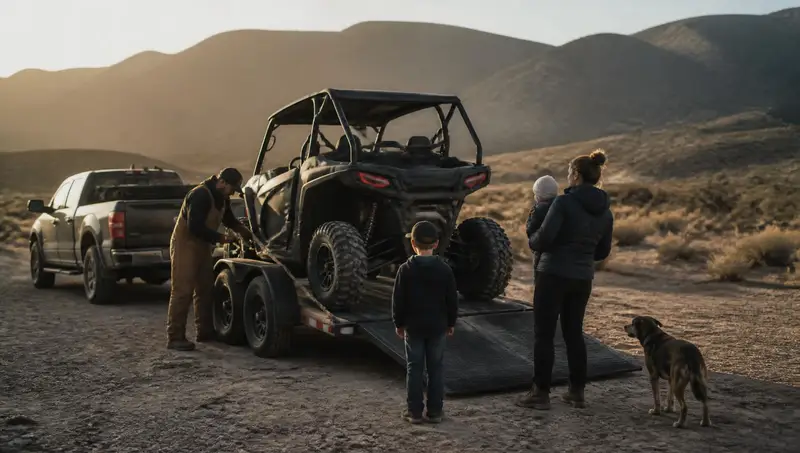
The same unit works a fence line on Monday and a trail on Saturday.
One machine, two buyers. The dealership sells to both without changing how it takes payment.
Deposits, financing and account customers
From a $30 fitting to a fleet purchase order.
The transaction mix inside an ATV or UTV dealership swings hard in a single day: a tire sale at the counter, a deposit on an incoming unit, a lender funding the balance of a financed purchase, and a municipal buyer working through a purchase order and invoice rather than a card at the till. Fizel sets the account up around that real mix, not a single retail template, so none of it is treated as unusual.
Deposits are their own workflow. A customer holds an incoming side-by-side, commits to a set of attachments or authorizes a major service job before parts arrive. That deposit can be taken at the desk, sent as a payment link, collected through a hosted payment page or keyed through the virtual terminal, with the balance from the customer or their lender handled the same way when the unit is ready.
For larger dealerships and dealer groups, custom pricing is available based on processing volume, transaction mix, locations and payment channels: see pricing for the $10M+ path.
Fizel provides payment acceptance. We do not finance or lend against unit purchases.
Attachments and heavy parts
A winch or a plow blade, not just a helmet.
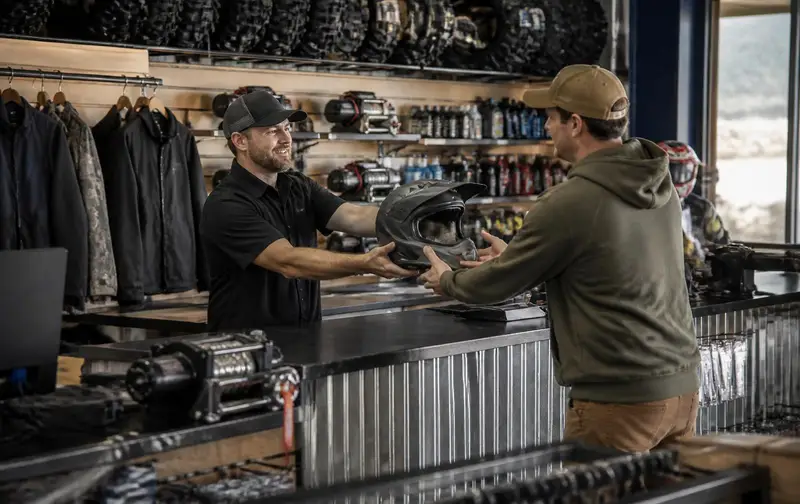
Tires, winches, plow blades and cab enclosures move alongside helmets, apparel and oil, and they change what a unit sale looks like at checkout. A work buyer often adds several hundred to several thousand dollars in attachments before a machine leaves the yard, fitted on site rather than boxed and carried out.
These attachment sales sit alongside fast, frequent counter transactions for recreational riders, and both belong in the same payment environment, with in-person acceptance covered under accepting payments and online orders under selling online.
Payment capabilities
Payment tools for a dealership serving two kinds of buyer.
Not every dealership needs every piece. Most start with what carries the counter and service bay, and add account billing or a second location as the customer base grows.
On the lot
- Countertop terminals for the showroom, parts counter and service desk
- Wireless terminals for the yard, delivery bay and prep area
- Tap to Pay on supported devices for demo days and off-site events
- Merchant accounts configured around the dealership's real transaction mix
Away from the counter
- Payment links for deposits, special orders and completed service work
- Virtual terminal for card details taken over the phone
- Invoicing for service, installations and commercial accounts
- Deposits and pre-authorizations where the workflow calls for them
Online and across locations
- Ecommerce payments, gateways and hosted payment pages for parts and gear
- Recurring and scheduled payments where a charge genuinely repeats
- Multi-location payment environments with consolidated reporting
- Funding that generally lands the next business day
The full range is on our solutions page. Invoicing, recurring billing and reporting sit under running your business.
Keep the systems that work
Account customers and consumer sales, one setup.
Most dealerships already have a retail point-of-sale, a work-order system for the service bay, an inventory setup and an accounting process a controller trusts, plus a way of billing the farms, contractors and municipalities on account. Replacing all of that at once is nobody's idea of a plan.
So we start with where payments actually touch the operation: what rings the parts counter, what closes a purchase order, what settles a work order, what the bookkeeper needs at month end. Fizel connects to compatible existing systems where practical and improves the payment pieces that need improving.
Fizel is the payment layer. Your inventory, service history and customer records stay exactly where they are, and the right integration for your setup is confirmed with you before anything changes.
Demand across the calendar
Work buyers and recreational riders keep different clocks.
A ranch or a municipality buys and services equipment on its own schedule, largely independent of riding weather. Recreational demand still rises around trail season and long weekends, but a farm needing a UTV for calving season or a contractor plowing through winter keeps the counter and the service bay busy well outside that window.
Fizel works with businesses whose volume spreads across most of the year rather than concentrating in one stretch, so activity in a quieter recreational month is treated as ordinary rather than flagged as unusual.
Work orders don't wait for spring
Farms, ranches and municipalities buy and service equipment on their own schedule, not the trail calendar.
Service carries the shoulder
Invoices and payment links keep revenue moving when the showroom slows down.
Preseason deposits
Deposits and lender paperwork taken well before a unit or attachment arrives on the lot.
Clear reporting
Visibility into what has been collected, with funds generally landing the next business day.
From the lot
The purchase order and the deposit slip come in the same week.
A municipality calls about a purchase order for three units with plow blades before the first snow. The same week, a family puts a deposit down on a side-by-side for a fall trip, and a rancher drops off a machine that needs a winch replaced before calving starts. None of it is out of the ordinary.
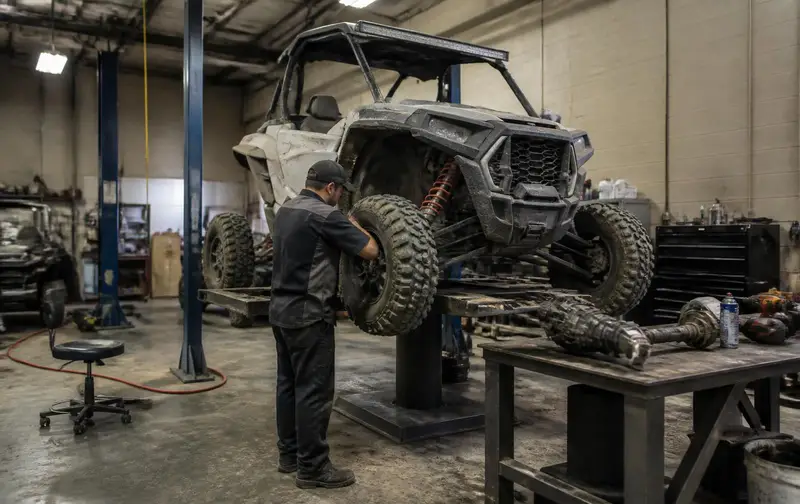
The service bay stays busy long after the showroom traffic slows: a contractor's fleet coming in for off-season maintenance, a plow mount repaired mid-winter, a suspension package quoted before the trails open. Sales close in the spring and fall, invoices go out all year, and the counter rarely goes quiet for long.
Larger dealerships and dealer groups
One payment environment across departments and locations.
Showroom, parts, accessories, service, online and, where applicable, several locations, each with its own rhythm, all reporting to the same business.
Work and ag accounts
Purchase orders and invoiced billing for farms, ranches, contractors and municipalities, running alongside consumer card sales.
Attachments and parts
Winches, plow blades, cab enclosures and tires ring through the same environment as a unit deposit.
Online
Ecommerce, hosted payment pages and payment links for parts, deposits and customers who order remotely.
Multiple locations
Multi-location processing with consolidated reporting, so each store runs its own way under one relationship.
Demo days and events
Wireless terminals and Tap to Pay on supported devices for sales taken away from the dealership.
Existing systems
Connect to compatible systems already in use rather than replacing what the dealership depends on.
How Fizel fits
- Showroom
- Deposits and customer payments on ATVs, UTVs and side-by-sides, without treating a larger transaction as an exception.
- Parts & accessories
- Fast in-person payments for tires, riding gear, winches, racks and upgrades at the counter.
- Service department
- Take payment at pickup, or send an invoice with a payment link for maintenance, repairs and installations.
- Online & remote
- Hosted checkout, payment links and the virtual terminal for parts orders, deposits and phone payments.
Pricing
Transparent pricing, quoted on your volume.
Dealership pricing depends on the mix. Consumer card sales, financed and deposited units, parts and attachments, and invoiced purchase orders from work and ag accounts all behave differently. Rather than publishing a rate that will not apply to your operation, we quote on your actual volume, channels and card mix. Pricing is month-to-month, with custom pricing for dealerships and groups processing $10M+ annually.
Further reading
How to Choose the Right Payment Processor for Your Outdoor Business
What to compare when a business serves both account customers and consumer buyers across several departments: pricing structure, integrations, settlement and support.
Read the guideQuestions
ATV and UTV dealer payments, answered.
Can Fizel support both purchase orders and consumer card sales?
Yes. Work and agricultural buyers, including farms, ranches, contractors and municipalities, often pay against a purchase order or invoice on account terms, while recreational customers pay by card at the counter or online. Fizel sets the account up around that mix rather than a single retail profile, so an account customer and a walk-in are both handled correctly.
Can we keep our existing dealership software?
That is the starting point. Fizel integrates broadly across point-of-sale, ecommerce, accounting, inventory and service or work-order systems. We look at how the dealership already runs, keep what works, and confirm the right integration for your specific setup before anything changes. Fizel is the payment layer, not your management software.
Can Fizel support the showroom, parts counter and service bay?
Yes. Terminals cover the showroom, parts counter and service desk, including counter sales of heavy parts like tires and plow blades, while payment links, invoicing and the virtual terminal cover payments that happen away from a counter. Everything runs in one payment environment with reporting across it.
Can customers leave deposits before a unit or lender financing is finalized?
Yes. A deposit can be taken by payment link, through a hosted payment page, or over the phone using the virtual terminal, and the balance from the customer or their lender can be collected the same way or in person at pickup.
Can we invoice attachment installs and service work separately from a unit sale?
Yes. Winch installs, plow blade fitting, cab enclosures and general repairs can be invoiced by email with a payment link so the customer settles before pickup, or paid in person when they collect the machine. More on this is under running your business on the solutions page.
Can Fizel support online parts orders and phone sales?
Yes. Ecommerce payments, gateways and hosted payment pages cover parts and attachment orders online, and the virtual terminal covers card details taken over the phone. Both run under the same merchant account as the counter.
Can Fizel support multiple dealership locations?
Yes. Multi-location payment environments with consolidated reporting are supported, so a dealer group can see showroom, parts, service and account customer revenue across every location while each site keeps the terminals and workflows it needs.
How does pricing work for a dealership with a large parts and service business?
Pricing is quoted on your actual volume, transaction mix, channels and locations rather than published as a single rate, and terms are month-to-month. Dealerships and dealer groups processing $10M or more annually are quoted through the custom pricing path on our pricing page.
Something specific to your dealership? Contact us and we will give you a straight answer. Nearby businesses we work with include snowmobile dealers, powersports dealers, RV and powersports rentals, 4x4 and off-road shops and outdoor retailers.
Work accounts and recreational sales on one payment environment.
Tell us how the dealership sells, services, invoices and ships today, and we will build a quote around it.