
Paddlesports Rentals, Rafting & Outfitters
Payment Solutions for Paddlesports Rentals, Rafting & Outfitters
From advance bookings and guided trips to walk-up kayak and paddleboard rentals and payments taken at the waterfront, Fizel supports the different ways paddlesports businesses get paid across a season.
Advance payments and deposits, group invoicing, acceptance wherever the operation actually happens, funding that generally lands the next business day, and month-to-month terms you can pause when the season ends.
The operating reality
The day on the water starts long before the put-in.
A guest remembers four hours on a river. The operator remembers everything required to get twenty-eight people from an online reservation to a put-in safely, efficiently and on schedule.
Before the first paddle stroke, the business has already handled reservations, deposits or full payment, a group that changed size twice, boats and equipment, a guide roster, vehicles and shuttles, a run of customer emails, and a water level that decided overnight what the day would actually look like. Then everyone arrives at the same time.
Fizel specializes in the outdoor economy and brings enterprise payment capability to it. For a paddlesports operation that means advance reservations and deposits, group payments, acceptance at the base and away from it, internationally issued cards and higher-value bookings, under one merchant relationship, built around a calendar that is nothing like a retail year.
From the first booking to the last boat off the water.
The commercial day
Reservation to launch
Most of the transaction happens before the operational day begins.
By the time a guest is holding a paddle, the money has usually moved: online, by link, by invoice or over the phone. What is left at the base should be the exception, and it should take seconds.
01
Reserve
A guest picks a date and a departure time online, weeks or months ahead, in whatever reservation system the business already runs.
02
Pay
A deposit or the full trip price is taken online, by payment link, invoice or over the phone, long before anyone reaches the base.
03
Arrive
Everyone turns up inside the same twenty minutes. Two more people joined the group. One balance is still outstanding.
04
Gear up
PFDs, helmets, paddles, a safety talk. Any last charge has to clear while a guide is fitting a life jacket.
05
Launch
Vans leave on time and the trip runs. Commercially, most of the work already happened.
Ecommerce and gateways, hosted payment pages, payment links, deposits, scheduled payments, a virtual terminal and invoicing cover that whole arc. The reservation calendar, participant management, waivers and trip logistics stay in the operator software you already run. Fizel is the payment layer underneath it.
Sound like your business? Tell us how you take payments today and we'll put together a quote built around it.
The morning rush
Seven forty-five, three departures, one parking lot.
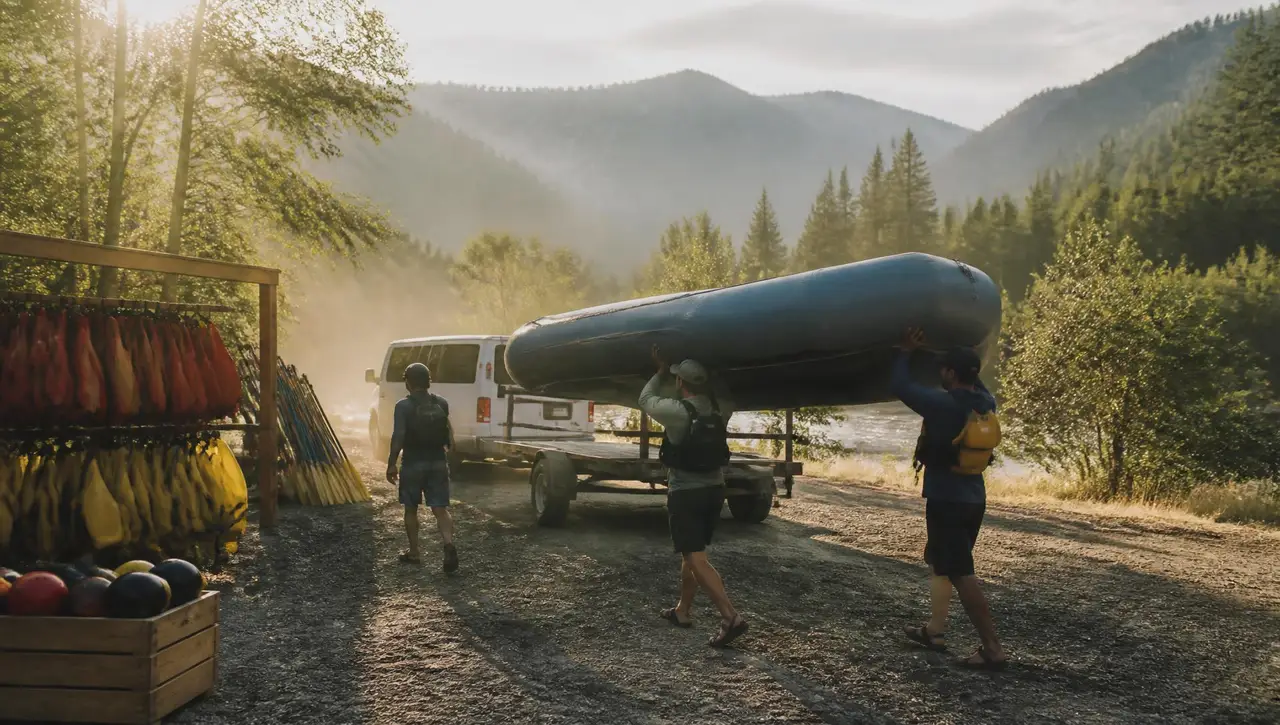
Peak season at a busy base is a compressed hour. Guides are pulling boats off the trailer. Helmets and PFDs are going out by size. A family of six has arrived early and a group of twenty is late. Someone brought a cousin who is not on the manifest. One corporate booking still has a balance outstanding, and the person who arranged it is not here.
Meanwhile the vans need to leave to hit a launch window, and the afternoon departure is already checking in behind the morning one.
Payments have to disappear into that hour. A tap at the check-in table, a link sent to the person who is actually paying, an added participant charged in fifteen seconds by whoever is nearest a device. Nothing about a payment should ever be the reason a departure leaves late.
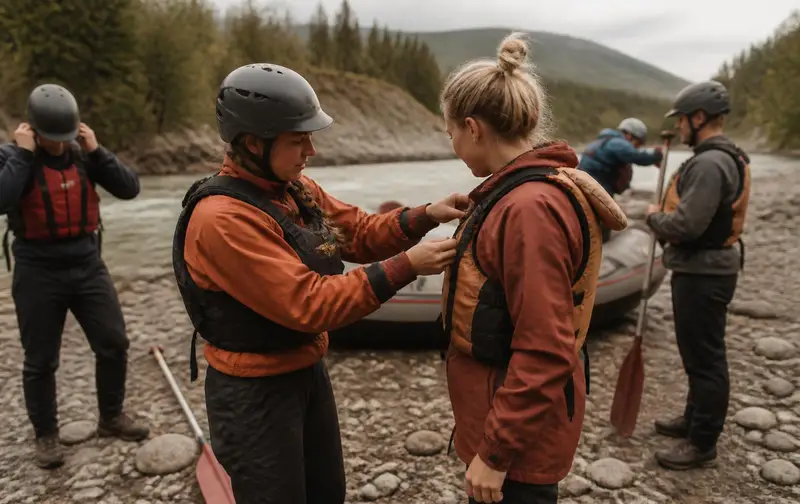
Everyone books at a different time. Everyone arrives at once.
Peak season
Who this is for
Guided paddlesports, in most of its forms.
Not every operator runs boats on whitewater, and not every one of these businesses offers rentals or instruction. What they share is scheduled departures, groups, advance money and a season with hard edges.
Whitewater rafting companies
Scheduled departures, guide crews, shuttles and a season shaped by flows and summer travel.
River rafting outfitters
Half-day, full-day and overnight trips run out of a base, often with several launches a day at peak.
Kayak and canoe outfitters
Guided trips, instruction and shuttle logistics on rivers, lakes and slow water.
Sea kayaking operators
Coastal day tours and multi-day trips where tides, weather and destination travel drive the calendar.
SUP and paddlesports companies
Tours, lessons and clinics, often alongside a rental fleet and a small retail operation.
Kayak, canoe and SUP rental businesses
Hourly and daily rentals from a hut, a beach or a dock, with walk-up demand that moves with the forecast.
Waterfront and resort-based operators
A rental and paddle programme run from a lakeshore, a marina beach or a resort waterfront rather than a storefront.
Multi-day and multi-location operators
Several bases, several activities, several teams, and one finance office reconciling all of it.
For adventure travel more broadly (multi-day expeditions, trekking and destination tours), our adventure tour operators page is the wider commercial page, and commercial whitewater and river trip operators are covered in detail on our rafting companies and outfitters page. Businesses built primarily on renting equipment rather than guiding trips are covered by outdoor equipment rentals.
Group bookings
One trip, one invoice, eighteen people who all pay differently.
Families, corporate teams, schools, camps, clubs, wedding parties and private charters can be a meaningful share of a season, and almost none of them behave like a single online reservation. A deposit holds the date months out. Numbers move. One organizer pays for everything, or twelve people pay individually, or a school district needs a purchase order and an invoice.
Deposits, invoicing, payment links, scheduled payments, a virtual terminal and customer-not-present acceptance cover those workflows, and reporting reads them as one business rather than a pile of unrelated transactions. Group bookings also tend to be the largest tickets on the calendar, an environment Fizel supports well.
Deposit amounts, headcount deadlines, cancellation terms and refunds are yours to set. We make sure the payment mechanics never become the awkward part of the conversation.
Waterfront operations
There is often no counter to stand behind.
A paddlesports business might have a base with a check-in desk, or a rental hut with a serving window, or a folding table under a canopy on a beach, or a dock at a resort waterfront, or a second location forty minutes upriver, or a van that is the office from May to September. Payments have to work at all of them: at the base, at check-in, beside the water, at a launch and at another site on a busy weekend.
Countertop terminals where there is a counter, wireless terminals where there is not, mobile payments, Tap to Pay on supported devices and payment links cover that ground. Coverage is still coverage: signal is not reliable at every river access or remote shoreline, so sensible operations lean on advance payment and links where the canyon has no bars, and take the rest in person.
Instruction and programs
Where the operation sells more than a seat on a trip.
Alongside the trip calendar, many operators run lessons, clinics, certifications, skills courses and multi-day programs. Those revenue lines have their own payment shape: advance payment for a course booked in winter, a deposit against a place in a program, a balance settled weeks later, an invoice for a club or school that books the whole session.
Ecommerce, payment links, deposits, scheduled payments, invoicing and a virtual terminal handle those without a separate merchant arrangement for each. Course rosters, instructor scheduling and certification records stay in whatever software already tracks them.
The waterfront is the checkout.
Where the transaction happens
Advance bookings and walk-ups
One booked in February. One decided twenty minutes ago.
A guided sea kayaking trip might be paid for four months before the guest arrives, through a website, a payment link or a deposit followed by a balance. That money moves long before anyone sees the water, and the operation plans a season around it.
The same business can also serve the opposite customer entirely. Someone walks down to the shore on a warm Saturday, sees the boards on the rack and wants a paddleboard for two hours. There is no reservation, no account and no advance notice. They are standing at the hut with a phone in their hand, and the transaction has to happen in under a minute or it does not happen at all.
Most paddlesports operators live somewhere between those two customers, and the mix moves with the weather. A payment setup built only for advance ecommerce misses the walk-up; one built only for a terminal misses the trip booked from another country. Ecommerce and gateways, hosted payment pages, payment links and deposits cover the first. Wireless terminals, mobile payments and Tap to Pay on supported devices cover the second. Both sit inside one merchant relationship and one set of reporting.

Rental operations
Inventory that goes out and comes back several times a day.
Kayaks, canoes, paddleboards and rafts where the operation runs them, plus the paddles, PFDs, dry bags and other equipment that go out with every one of them. Depending on the model, a rental might be paid in full online, held with a deposit, paid in person at pickup, covered by a pre-authorization, or extended when the customer decides to keep the board for a third hour.
Fizel supports deposits and pre-authorizations where they are appropriate, and additional charges taken at return. A pre-authorization is a payment tool, not a guarantee of recovery for lost or damaged equipment. Your rental terms, deposit amounts and process still do that work. We do not set them and we do not manage the inventory behind them.
Between customers, the business keeps working while nobody is paying it. Boats come off the water and back onto racks. PFDs are returned, checked and re-sized for the next group. Paddles are counted. Gear is rinsed and organized. The next departure is already being fitted while the last one is still on the water. On a peak summer day that cycle repeats until closing, and a payment step that takes ninety seconds instead of ten is felt every single time.
For businesses where renting equipment is the whole model rather than one line alongside guiding, our outdoor equipment rentals page is the broader commercial page, and boat rentals and charters covers motorized fleets, charters and marina-based operations.
An observation
The best operations look effortless from the parking lot.
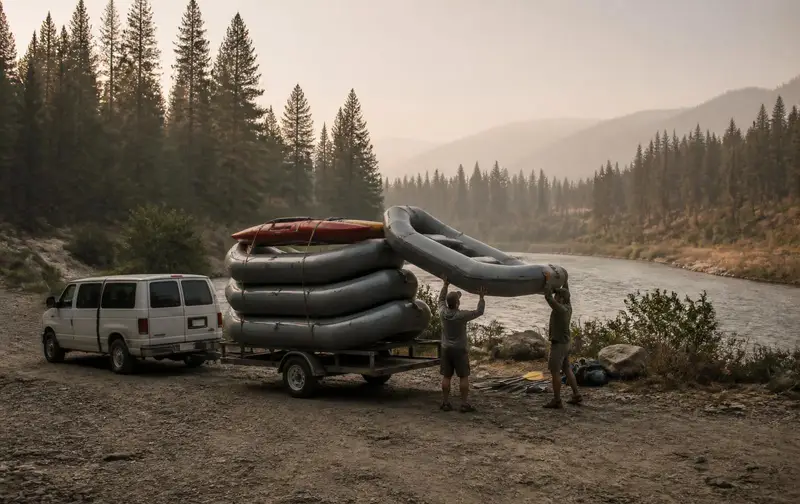
Watch a good outfitter at eight in the morning and it looks calm. Boats come off the trailer in the right order. Someone has already sized helmets for the group that has not arrived yet. A guide walks a nervous first-timer through the safety talk twice without making it obvious. Nothing in that hour is accidental: it is the product of years of running the same twenty minutes, several times a day, through a season short enough that there is no room to be disorganized. The guests never see any of it. They see a river.

Destination and international guests
They booked the trip before they booked the flight.
Operations in major outdoor destinations serve people who are not local and were never going to be. Their card was issued in another province, another state or another country, and the transaction happened weeks before they landed.
Internationally issued cards, multiple currencies and FX/DCC are established Fizel capability, online and in person, alongside advance and customer-not-present payments and higher-value group bookings. A visitor from overseas paying a group deposit in February is ordinary business, and we set the account up expecting it.
When the season is the business
For many operators, the season is not a busy period. It is the year.
A snowmelt-driven river company, a coastal sea kayaking operator and a lake canoe outfitter do not share a calendar. One is watching flows and a runoff window measured in weeks. One is watching ocean conditions and destination travel. One is watching school calendars, holiday weekends and the weather on a Saturday in July.
What they have in common is concentration. A large share of annual revenue can arrive inside a short operating window, while the booking money arrives on one schedule and the costs (boats, vehicles, equipment, permits, insurance, a crew hired for the summer) arrive on another. Funding that generally lands the next business day matters far more in that pattern than it does in a flat retail year.
And when the water drops and the vans go into the shed, the account should be able to stand down with the rest of the operation.
Month-to-month. No locked-in contracts.
Seasonal businesses can pause their merchant account during the off-season.
- Pause through a genuine off-season instead of carrying a dormant account
- Restart before booking season rather than starting over
- Funding generally next business day while you're operating
- Booking spikes months ahead of the season expected, not flagged
- Pricing quoted on your season, not a flat annual average
Multiple revenue streams
The trip price is rarely the whole day.
Few operators run all of these and some run only the first. Where they exist, they can sit inside the same broader merchant environment rather than a separate arrangement each, with the operating software behind them staying whatever you already use.
- Guided day trips and scheduled departures
- Private and custom trips
- Multi-day river programs
- Group and corporate bookings
- Instruction, clinics and certifications
- Rentals, where the operation offers them
- Trip photography
- Retail and branded merchandise
- Shuttles and transportation
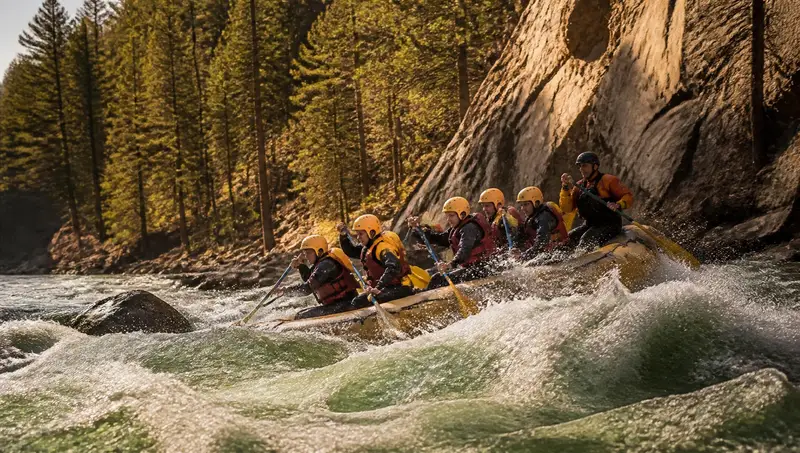
Four hours on the water. Eleven months of running a business.
The part the guest books. The part everything else exists to deliver.
Payment capabilities
Before the trip, during the rush, across the business.
Before the trip: ecommerce and payment gateways, hosted payment pages, payment links, deposits and scheduled payments. For groups and remote payers: a virtual terminal, invoicing and customer-not-present acceptance. At the operation: countertop and wireless terminals, mobile payments, Tap to Pay on supported devices, POS and integrations.
Across the business that means merchant accounts built for higher-ticket environments, internationally issued cards, multiple currencies and FX/DCC, recurring and scheduled payments where they apply, deposits and pre-authorizations where appropriate, multi-location environments, consolidated reporting and broad integrations. The full range is on our solutions page. Terminals, mobile payments and Tap to Pay at the put-in are covered under accepting payments in person.
See the platforms Fizel works with for a sense of the booking, POS, ecommerce and accounting systems payments can connect to.
Existing systems
We start with the reservation and waiver system you run.
By the time an operator talks to us there is usually a reservation or booking platform in place, a waiver system, sometimes rental-management software, a POS, an ecommerce site and accounting software that everything reconciles into. Replacing that stack in March is nobody's idea of an improvement.
Fizel integrates broadly across commerce and business systems. We start with how the operation runs today and build the payment environment around it; the specific integration for your stack is confirmed during setup. That operator software belongs to its vendors. We are the payment layer beneath it, not a replacement for it.
Independents and larger operators
One base or six, the payment picture should be one picture.
A respected single-river outfitter and an operator running several bases, activities and destinations need different things from a payments partner, and Fizel is built for both. Multi-location environments, consistent acceptance across sites and channels, consolidated reporting and centralized visibility mean a finance office can see the whole season across every location and revenue line rather than reconciling separate arrangements.
Support, settlement and terms
A payment problem at 7:30 a.m. is not an ordinary support ticket.
Three trips are checking in and a terminal is not behaving. A generic queue does not understand why that is urgent, or why a rafting company takes most of its money in a fourteen-week window. Fizel provides knowledgeable human payments support from people who understand the businesses behind the transactions.
Funding generally lands the next business day, terms are month-to-month with no locked-in contracts, and seasonal operators can pause the account when the season ends.
How Fizel fits
- Trip deposits
- Hold a raft or a paddling date with a deposit taken at booking.
- At the put-in
- Tap to Pay on supported devices settles balances and walk-ups at the launch site.
- Group bookings
- Payment links let a group organizer pay a balance without standing at a counter.
- Weather calls
- Refunds and rescheduled deposits handled quickly when a river day gets pulled.
Pricing
Priced around a fourteen-week season, not a flat year.
A single-base day-trip operation prices differently from a multi-day river outfitter with group business, instruction and two locations. We quote on real volume, average and high ticket, the split between advance and in-person payments, group and international card share, the shape of your season and the systems already in place. Month-to-month, with no locked-in contracts.
Further reading
How Seasonality Shapes Outdoor Businesses
Why a compressed operating window changes how a business should think about funding, terms, booking-season volume and the months when nothing is trading, plus how guiding and outfitting businesses evaluate a payments partner across deposits, advance bookings and in-field acceptance.
Questions
Paddlesports rental and outfitter payments, answered.
Can Fizel support online reservations and advance payments?
Fizel supports the payment side of them, which is usually where the friction is. Ecommerce and payment gateways, hosted payment pages, payment links, deposits and scheduled payments all sit in one merchant environment, so a trip paid for in March and a balance settled in July are part of the same payment relationship. The reservation calendar, departure times, participant lists and waivers stay in the operator software you already use. Fizel is not booking or waiver software and does not replace it.
Can we take deposits and balances for group bookings?
Yes. Group business rarely behaves like an individual reservation: a school, camp, club, corporate team or wedding party may hold dates with a deposit, confirm numbers later and settle a balance close to the departure date. Deposits, invoicing, payment links, scheduled payments, a virtual terminal for phone bookings and customer-not-present acceptance cover that pattern. The deposit amounts, change deadlines, cancellation and refund terms remain your policies; we move the money, not the rules.
Can we take walk-up and mobile payments at a waterfront location?
Yes, and for many paddlesports operations that is the harder half of the job. Wireless terminals, mobile payments, Tap to Pay on supported devices and payment links let you take a payment at a rental hut, on a beach, at a dock, at check-in, at a put-in, at a second base or from a vehicle, with countertop terminals where there genuinely is a counter. Cellular and internet coverage is not guaranteed at every river access or remote shoreline, so most operations pair in-field acceptance with advance payments and payment links for the places where signal is thin. That is a practical planning point rather than a limitation of the payment setup.
Can we use deposits or pre-authorizations for rental equipment?
Yes. Depending on how you run rentals, a kayak, canoe, paddleboard or gear package might be paid in full online, held with a deposit, paid in person at pickup, covered by a pre-authorization, or extended with an additional charge when the customer keeps it longer. Fizel supports deposits, pre-authorizations where appropriate and additional charges taken at return. A pre-authorization is a payment tool, not a guarantee of recovery for damaged, lost or unreturned equipment. Your rental terms, deposit amounts and return process still do that work, and Fizel does not set them or manage the inventory behind them.
Can Fizel work with our existing reservation or waiver system?
That is the intended starting point. Most operators already run a reservation or booking platform, a waiver system, sometimes rental-management software, a POS, an ecommerce site and accounting software behind all of it. Fizel integrates broadly across commerce and business systems, and the specific integration for your stack is confirmed during setup. We do not build, own or replace reservation, waiver or trip-management software: we fit the payment layer into the environment you already run.
Can we accept internationally issued cards and multiple currencies?
Yes. Rafting and paddlesports businesses in major destinations serve guests who booked the trip from another province, state or country and paid before they travelled. Fizel supports internationally issued cards, multiple currencies and FX/DCC, online and in person, along with advance and customer-not-present transactions and higher-value group bookings. A visitor paying in advance from overseas is ordinary business for a destination operator.
Can we pause our merchant account during the off-season?
Yes. Fizel is month-to-month with no locked-in contracts, and seasonal businesses can pause their merchant account during the off-season rather than carrying it through months with no trading. Tell us the shape of your season: snowmelt and flows, summer tourism, school calendars, holiday weekends, the booking spike that arrives months before the water does, and the account is set up around it. While you are running, funding generally lands the next business day.
Something specific to your operation? Contact us and we will give you a straight answer. More on how we work with this segment is on the adventure travel and tours industry page.
Priced for the season you actually operate.
Tell us how you take reservations, handle groups, run the base and close out the season, and we will build a quote around it.