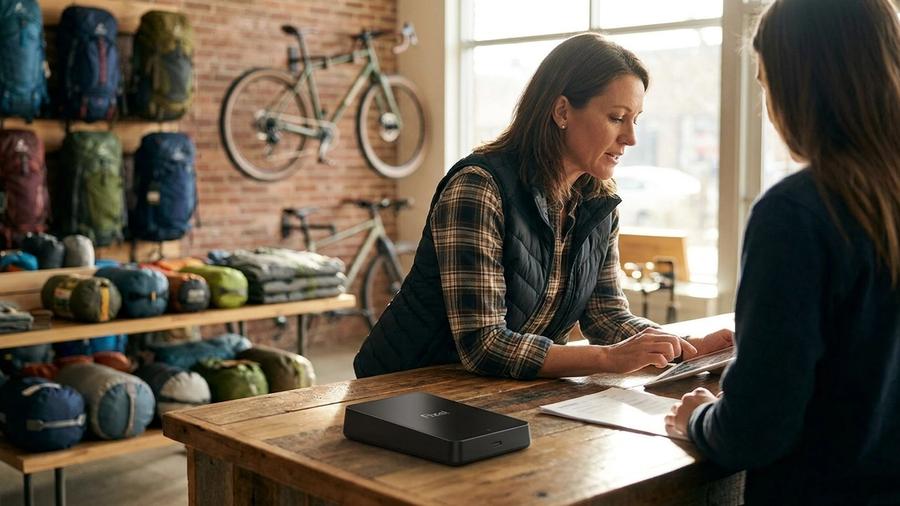

Outdoor brands rarely operate through a single sales channel.
A growing brand might sell directly through its own ecommerce store, supply independent retailers and dealers, take wholesale orders from larger accounts, attend consumer shows and industry events, operate a showroom or factory store, and collect payments from distributors or commercial customers.
That makes payments more complicated than simply choosing a provider for an online checkout.
For outdoor brands and manufacturers, the right payment setup needs to support the way money actually moves through the business, across direct-to-consumer ecommerce, wholesale, B2B sales, events, physical locations and potentially multiple countries.
This guide explains what outdoor brands and manufacturers should consider when evaluating payment processing, and how to build a payment environment that can grow with the business.
Outdoor manufacturing is a significant part of the outdoor economy
Outdoor products sit inside a much larger economic ecosystem.
According to the U.S. Bureau of Economic Analysis, the U.S. outdoor recreation economy generated $696.7 billion in value added in 2024, representing 2.4% of U.S. GDP.
Manufacturing alone contributed $91.3 billion in outdoor recreation value added, about 13.1% of the total, making it the third-largest industry group in the outdoor recreation economy behind arts, entertainment, recreation, accommodation and food services, and retail trade.
Outdoor retail is also a substantial market. Outdoor Industry Association reported approximately $28 billion in U.S. outdoor retail sales in 2024, up 1% from 2023.
These numbers include a wide range of businesses and should not be read as the revenue of outdoor brands alone. They do, however, show the economic scale of the ecosystem in which outdoor manufacturers and brands operate.
For payment purposes, what matters is that much of this commerce eventually flows through brands, retailers, dealers, distributors and ecommerce channels. Our outdoor industry payment statistics collection covers the wider transaction picture in more detail.
Why payments are different for outdoor brands
An independent outdoor retailer may primarily accept payments at a store counter and through an ecommerce website. A brand can have a very different revenue model.
Consider a company manufacturing bikes, skis, technical apparel, climbing equipment, marine products or camping gear. Its revenue might include:
- Direct-to-consumer ecommerce
- Wholesale orders from independent retailers
- Dealer sales
- Distributor payments
- Factory-store or showroom sales
- Consumer events and trade shows
- Telephone or email orders
- International customers
- Deposits on large or custom orders
- Recurring dealer or commercial accounts
Those transactions do not necessarily belong in the same payment workflow. A $120 ecommerce purchase, a $12,000 dealer order and a $75,000 distributor invoice create very different economics and operational requirements.
The goal should therefore be to design the payment environment around the business, rather than forcing every transaction through the same checkout.
The major payment channels outdoor brands need to consider
1. Direct-to-consumer ecommerce
DTC ecommerce has given outdoor brands a direct relationship with consumers that historically belonged mostly to retailers and dealers. That means the brand becomes responsible for the entire payment experience: checkout, authorization, fraud controls, refunds, disputes and reconciliation.
Ecommerce is now a major part of retail overall. U.S. Census Bureau data shows ecommerce represented 16.6% of total U.S. retail sales in the fourth quarter of 2025.
For outdoor brands, the share can vary substantially by product category and distribution strategy. A digitally native apparel company may generate most of its consumer revenue online, while a boat, bike or equipment manufacturer may rely much more heavily on dealers. The payment system should fit the actual channel mix rather than assuming every outdoor brand is primarily an ecommerce company.
Key ecommerce considerations include:
- Checkout conversion and mobile checkout
- Gateway compatibility with the existing platform
- Digital wallets and preferred payment methods
- Fraud controls and international cards
- Refund management and ecommerce reporting
- Cost per transaction
If the existing ecommerce platform works well, replacing the entire technology stack simply to change payment providers may not make sense. Start by determining what can be retained, then look at what online payment options fit around it.
2. Wholesale and dealer payments
Wholesale payments are where the economics change significantly. A consumer might buy a $250 jacket. A retailer could place a $15,000 seasonal order. A dealer might purchase $40,000 of inventory.
Running every large B2B invoice through the same card-not-present pricing used for consumer ecommerce can become expensive. As an arithmetic example, a difference of only 0.50 percentage points in the effective cost of accepting a $25,000 payment equals $125 on a single transaction. Across $2 million of annual card-based wholesale volume, the same 0.50 percentage-point difference equals $10,000 per year.
This is why outdoor brands should look at B2B payments separately from DTC checkout. Depending on the customer and transaction, payment methods might include:
- Credit cards and commercial cards
- ACH or bank payments, and EFT in Canada
- Wire transfers
- Virtual terminal transactions
- Payment links and invoice payments
The cheapest method is not automatically the best method. Some commercial buyers prefer cards for convenience, internal purchasing policies, rewards or working-capital reasons. The objective is to understand the economics and give the business appropriate options, including invoicing and virtual terminal tools for orders that never pass through a checkout page.
Card acceptance costs matter more as ticket size increases
Payment processing is usually discussed in percentages, but brands should also convert those percentages into dollars.
Suppose an outdoor manufacturer accepts $5 million annually in card payments. A 0.25 percentage-point difference in effective processing cost represents $12,500 per year. At $20 million of card volume, the same difference represents $50,000 per year. These are arithmetic illustrations, not quoted rates.
That does not mean the lowest quoted rate is necessarily the best provider. Reliability, authorization performance, reporting, integrations, support, contract terms and operational fit also matter, the same trade-offs covered in our guide to choosing a payment processor. But once payment volume becomes meaningful, seemingly small pricing differences deserve attention.
Understand the difference between consumer and commercial cards
Not every card transaction costs the same amount to process. The underlying economics can vary according to factors including:
- Card type, and consumer versus commercial card
- Rewards level and country of issuance
- Card-present versus card-not-present
- Transaction data submitted
- Merchant category and processing configuration
This matters most for brands with significant dealer, distributor or corporate purchasing activity, where transactions may involve purchasing, corporate or business cards rather than ordinary consumer cards. Brands with meaningful B2B volume should understand their transaction mix rather than judging payment costs from a single advertised rate, interchange pricing explains why two similar-looking transactions can cost different amounts.
B2B transaction data can matter
Some commercial card transactions can qualify for different interchange treatment when additional transaction information is submitted correctly. Depending on the card network, the transaction and the processing environment, that can include information beyond the basic card number and amount.
For manufacturers and wholesalers with substantial commercial-card volume, the important question is not simply "what rate are we paying?" It is "how are our commercial transactions actually being processed?" The answer may reveal opportunities to improve transaction data, routing or payment workflows.
Returns are a payments issue too
Returns are particularly relevant for brands selling directly to consumers. National Retail Federation research estimated that 16.9% of annual U.S. retail sales would be returned in 2024, representing approximately $890 billion of merchandise. NRF also reported that average online return rates were 21% higher than retailers' overall return rates.
Outdoor categories have their own dynamics. Apparel and footwear can see sizing-related returns, while technical products can create more complicated warranty, exchange and service workflows.
A payment setup therefore needs to handle refunds efficiently and give finance teams enough information to reconcile:
- Original purchases and multiple captures
- Partial and full refunds
- Exchanges and shipping adjustments
- Taxes and disputes
Returns should not be treated as an edge case in the payment architecture. For many consumer brands, they are a normal part of the transaction lifecycle, and refund volume flows back through the same environment that processed the sale.
Events, trade shows and temporary selling locations
Outdoor brands frequently sell away from their primary location: consumer shows, demo days, festivals, races, competitions, trade shows, pop-up stores, product launches and dealer events.
Traditional countertop terminals may not be practical in these environments. Mobile payments and Tap to Pay can give staff a simpler way to accept transactions without building a permanent checkout station.
Before selecting an event-payment setup, consider cellular or Wi-Fi availability, expected transaction volume, average ticket, the number of staff accepting payments, receipt requirements, inventory integration, and whether those transactions need to flow into the same reporting environment as ecommerce or retail sales.
The best event setup is usually the simplest one that still reconciles properly afterward.
Deposits and pre-authorizations
Some outdoor products carry substantially higher transaction values than ordinary retail merchandise: boats, powersports products, custom bikes, specialty equipment, large dealer orders, custom manufacturing and commercial equipment packages.
These businesses may need to collect deposits before production, fulfillment or delivery. The workflow needs to clearly distinguish among a completed payment, a deposit, an authorization, a pre-authorization, a later capture and a refund. These are not interchangeable.
The appropriate structure depends on how the business sells, its fulfillment cycle, and what its payment provider and software support. Not every processor or integration supports every deposit or pre-authorization workflow, so this is worth confirming specifically rather than assuming.
International customers
Outdoor brands can become international businesses relatively early. A Canadian manufacturer may sell into the United States. A U.S. brand may have Canadian dealers. Ecommerce can introduce customers from many other countries.
International payments introduce additional questions:
- Which currencies are accepted, and which are settled?
- Who bears foreign-exchange costs?
- Are international cards priced differently, and are cross-border fees involved?
- Where is the merchant entity located?
- How are refunds handled when currencies move?
- Does the ecommerce platform support the required markets?
These questions become more important as international volume grows. A business should understand the full economics of a cross-border transaction rather than looking only at the headline processing rate.
Fraud and chargebacks
Direct ecommerce also exposes brands to card-not-present fraud and disputes. Outdoor products can be attractive fraud targets because many are high value, portable, resellable, shippable and in demand across borders.
A strong fraud strategy balances two competing objectives: stopping genuinely fraudulent transactions, and avoiding rejecting legitimate customers. Applying the strictest possible rules can reduce losses while also reducing legitimate sales.
Useful controls can include address verification, card security-code checks, device and behavioral signals, velocity rules, transaction risk scoring and manual review for unusual high-value orders. Available tools depend on the gateway, ecommerce platform and payment provider.
Omnichannel reporting becomes important as brands grow
One of the least glamorous payment problems is often one of the most expensive operationally: reconciliation.
Imagine a brand accepting payments through an ecommerce platform, a physical showroom, trade-show terminals, dealer invoices, telephone orders and payment links. If each channel has separate reporting, deposits and settlement schedules, finance teams can spend significant time working out which transactions correspond to which bank deposits.
The goal does not necessarily need to be one provider for everything. Sometimes separate systems are appropriate. The goal should be enough consistency and reporting visibility that the finance team can reconcile payments efficiently.
Should an outdoor brand use one payment provider for every channel?
Not necessarily. Consolidation can provide simpler reporting, fewer vendor relationships, easier reconciliation, consistent support and centralized transaction visibility.
But forcing every channel onto one provider can also create compromises. A specialized ecommerce platform may be excellent for DTC checkout while a different payment workflow suits high-value B2B invoices better.
The right architecture might therefore involve one provider or several. Start with how the company already operates. Keep systems that work well where practical, and improve the parts that create unnecessary cost, friction or manual work.
Questions to ask when evaluating payment processing
- Can we keep our existing ecommerce platform and gateway?
- How are our ecommerce and card-not-present transactions priced?
- How are commercial and purchasing cards handled?
- Can you support our wholesale and dealer payment workflows?
- What options exist for invoices and payment links?
- Can we accept payments at events and temporary locations?
- How are deposits and pre-authorizations handled?
- How are international cards and cross-border transactions priced?
- What fraud tools are available?
- How do refunds and chargebacks appear in reporting?
- Can transactions across multiple locations or channels be reported together?
- What are the contract terms?
- What support is available when there is a payment problem?
- What information do you need to provide an accurate pricing comparison?
The provider should be able to understand the business before recommending a setup.
What to review on your current processing statement
Before switching processors, establish a baseline. Review at least three recent months of processing statements where possible, using our guide to credit card processing fees to interpret the line items. Look for:
- Total card volume, number of transactions and average transaction size
- Effective processing cost, interchange charges and processor markup
- Monthly fees, gateway fees and PCI-related fees
- Cross-border charges and chargeback fees
- Refund volume, and card-present versus card-not-present mix
For seasonal outdoor companies, three months may not tell the whole story. If transaction patterns change materially throughout the year, reviewing a longer period produces a better picture.
A simple example
Consider an outdoor equipment company with the following annual payment mix: $4.0 million in DTC ecommerce, $2.0 million in wholesale and dealer card payments, and $500,000 across its showroom and events, for $6.5 million of total card volume.
The company should not evaluate the entire $6.5 million as one homogeneous pool of transactions. The DTC business may prioritize ecommerce conversion, fraud tools and integrations. The wholesale channel may prioritize commercial-card economics, invoices and alternative payment methods. The showroom and event business may prioritize terminals and mobility.
Breaking payment volume into channels makes it much easier to identify where improvements actually matter.
What Fizel can help with
Fizel works with outdoor businesses across Canada and the United States, including outdoor brands and equipment manufacturers. For these businesses, that can include evaluating payment requirements across ecommerce, merchant accounts, in-person payments, mobile payments, payment links, virtual terminals, invoicing, recurring payments, deposits and pre-authorizations, multiple locations and channels, and POS and payment integrations.
The starting point is not replacing everything. It is understanding how the business currently accepts payments, what is working, where friction or unnecessary cost exists, and what should change.
Talk to Fizel About Your Payment Setup → · Get a Quote →
Sources
- U.S. Bureau of Economic Analysis, Outdoor Recreation Economic Statistics, U.S. and States, 2024: outdoor recreation value added, share of GDP, manufacturing contribution.
- Outdoor Industry Association, 2025 Outdoor Retail Sales Trends Report: $28 billion in 2024 U.S. outdoor retail sales, up 1% year over year.
- U.S. Census Bureau, Quarterly Retail E-Commerce Sales, Fourth Quarter 2025: ecommerce as 16.6% of total U.S. retail sales.
- National Retail Federation / Happy Returns, 2024 Consumer Returns in the Retail Industry: 16.9% return rate, approximately $890 billion in returns, online return rates 21% higher than overall.
Dollar and percentage scenarios in this article ($12,500, $50,000, 0.25 and 0.50 percentage-point comparisons, and the $6.5 million channel mix) are arithmetic examples for illustration, not quoted rates, pricing offers or reported results.