

Fizel, Field Notes
Outdoor Brands & Manufacturers
Issue: Outdoor Brands
One Brand.
Many Counters.
Direct to consumer. Through dealers and distributors. In your own store, in your showroom, at a race in another country.
Fizel builds the payment environment behind all of it: enterprise capability, an outdoor-economy specialist, month-to-month.
The brand reality
The customer's route to your product is not a straight line.
Someone sees your pack on a trail. They handle it two weeks later at a specialty retailer three hundred kilometres away. They read about it, follow the brand for a season, and eventually buy it from you directly, in another currency, on a phone, at eleven at night.
That journey is the reason an outdoor brand ends up running several commercial models at once. Each one has a different buyer, a different ticket size, a different cadence and a different way of getting paid. Most payment setups are built for exactly one of them.
Fizel works across the outdoor economy and builds payment environments for companies that go to market in more than one direction at the same time.
Outdoor brands sit within the wider Outdoor Brands & Manufacturers category Fizel works across.

Before the season starts
A line exists on a table months before it exists on a shelf.
More than one way to sell
Four commercial models. One brand behind them.
Few brands run all four, and none of them run all four the same way. What matters is that the payment environment is designed around the mix you actually have, rather than the one channel a provider happens to be good at.
01
Direct to consumer
Your own storefront, your own margin, your own customer data, and the channel with the least tolerance for a checkout that hesitates.
- Ecommerce processing and gateways
- Hosted checkout and payment pages
- Internationally issued cards
- Multiple currencies and FX/DCC
- Recurring and scheduled payments where a programme calls for it
02
Wholesale and dealers
Specialty retailers, distributors and commercial accounts buy on terms, in season blocks, at values a consumer cart never sees.
- Invoicing for dealer and distributor orders
- Payment links sent against an order or a deposit
- Virtual terminal for keyed and phone orders
- Scheduled payments across a delivery window
- Higher-ticket transactions treated as normal volume
03
Brand retail and showroom
A flagship, a factory store, an outlet, a showroom where buyers see the line before they commit to it.
- Countertop and wireless terminals
- Multi-location environments reporting into one place
- Deposits and pre-authorizations where an order is held
- The same merchant relationship as the website
04
Events and activations
Races, festivals, demo days, trade events, pop-ups. Selling happens where the product is used, often with no fixed counter and no fixed address.
- Mobile terminals for temporary retail
- Tap to Pay on supported devices
- Payment links for orders taken on the spot
- Reporting that separates the activation from the rest of the business
The full capability set is on our solutions page. Ecommerce, hosted checkout and payment links are covered under selling online.
Sound like your business? Tell us how you take payments today and we'll put together a quote built around it.
Behind the wholesale order
A dealer order is a build, not a cart.
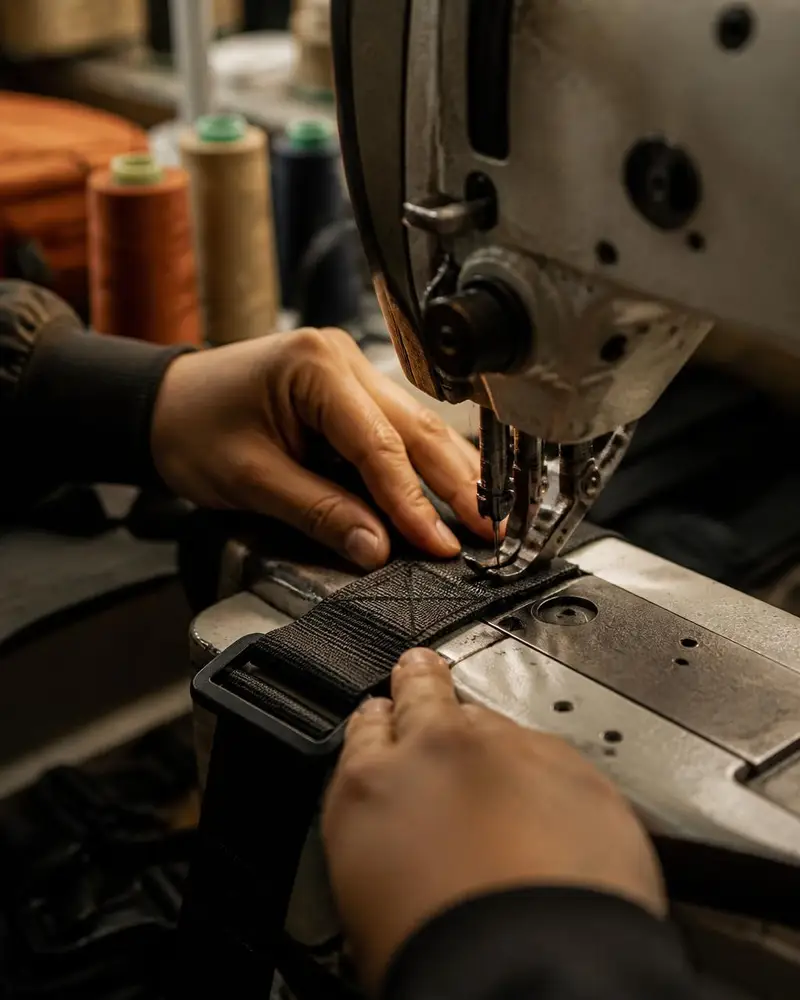
A consumer checkout closes in one card swipe. A dealer order closes after a purchase order, a production run, a delivery window and, often, a deposit taken well before the goods exist. The stitching happens first; the invoice follows weeks later.
Invoicing, payment links against a deposit or an order, a virtual terminal for keyed and phone orders, and scheduled payments across a delivery window are the tools that fit that shape, with higher-ticket wholesale transactions treated as ordinary volume rather than an exception to be manually approved.

Selling past the border
Your market is wherever the product ends up.
Outdoor products travel. A brand built in British Columbia sells into Colorado, then into Europe, then to a visitor who found the line in a shop while on a trip and buys directly from the website once they are home.
Internationally issued cards, multiple currencies and FX/DCC are established Fizel capabilities, and we treat cross-border demand as a normal commercial requirement rather than an exception to be managed. We configure for it at the outset, the mix of markets you sell into, the currencies you want to present, and how you want that reported.
For a brand doing meaningful volume, a checkout that quietly declines or confuses international buyers is not a technical detail. It is lost revenue in your fastest-growing market.
Start with the stack you already run
Integration is where this gets decided.
By the time a brand of any scale talks to us, there is already an ecommerce platform, a POS in the stores, an ERP or order management system behind wholesale, inventory that has to stay accurate across channels, accounting that closes on a schedule, and a CRM the marketing team lives in.
See the platforms Fizel works with for a sense of the ecommerce, POS, accounting and business systems payments can connect to.
Fizel integrates broadly across commerce and business systems. The work is not replacing your stack, it is understanding it, confirming the right integration path for each channel, and placing payments where they belong inside an environment you have already invested years and real money in.
Fizel is not your ecommerce platform, your ERP or your order management system, and does not try to become one. We are the payment environment underneath them.

Settlement and reporting
Revenue arrives in bursts. Costs do not.
Outdoor brands rarely earn evenly. A winter line, a spring launch, a holiday ecommerce peak, a dealer ordering window months before anything ships, the shape differs by category, but almost every brand has one. Production, inventory, paid media and payroll keep their own schedule regardless.
Funding is generally next business day, which matters most in the weeks a launch or a peak concentrates a quarter’s revenue into a handful of days. And because channels sit under one relationship, reporting shows DTC, wholesale, retail and events separately and together, instead of arriving as unrelated statements from unrelated accounts.

Field note
The product cycle no catalog shows.
A jacket sold next fall was probably sewn as a sample eighteen months earlier, argued over in a studio, and then handed to a handful of athletes and staff who wear it until it fails somewhere specific, a zipper that iced up, a seam that wicked instead of sealing.
Field testing is rarely glamorous. It is a pro-rider's feedback email after a wet weekend, a technician re-taping a seam by hand for the fourth revision, a production lead deciding whether a colourway is worth the tooling cost. The version that eventually reaches a dealer floor is the one that survived that process, not the one that looked best in the first sketch.
How we work with you
A payments partner, not a portal login.
Fizel is month-to-month, with no locked-in contracts. That is deliberate at every size. A brand doing serious volume should stay because the payment environment performs, not because an agreement makes leaving expensive.
The other half is who answers. A growing brand’s payment questions are rarely “the terminal is offline”, they are how to open a second market, what changes when wholesale overtakes DTC, how a new platform affects the gateway, why one channel reconciles differently from another. Fizel’s support is knowledgeable people who work in the outdoor economy every day and can think through those questions with your ecommerce, retail and finance teams.
Outdoor specialization on one side. Enterprise payment capability on the other. Most providers offer one or the other.
How Fizel fits
- Direct-to-consumer
- Hosted checkout handles the online storefront, launches and restock spikes.
- Wholesale orders
- Email invoicing and payment links collect dealer and wholesale balances on terms.
- Events & pop-ups
- Tap to Pay on supported devices and terminals cover demo days, trade shows and factory sales.
- One view of revenue
- Multi-channel processing and reporting under one account instead of separate silos.
Pricing
Priced on your business, not on a tier.
A brand at 70% DTC prices differently from one at 70% wholesale, and both price differently again once international volume, brand retail and event sales are in the mix. We quote on your actual volume, channel mix, transaction profile, geography and payment environment, not on a published average that will not describe you.
Further reading
The State of Outdoor Commerce in 2026
How outdoor businesses are selling now, the shift across direct, wholesale and physical channels, and what it means for the commercial infrastructure behind them.
Read the reportQuestions
Outdoor brand payments, answered.
Can we keep our existing ecommerce, POS and ERP systems?
Yes, and that is where we start. Fizel integrates broadly across ecommerce platforms, POS, ERP, order management, inventory, accounting and CRM systems. We map the stack you already run, keep what works, and design the payment architecture around it rather than asking you to rebuild commerce infrastructure you have already invested in.
We sell DTC, wholesale and through our own stores. Does that mean separate providers?
No. Ecommerce, invoiced dealer payments, in-person retail and event sales can all sit under one Fizel relationship, with reporting that lets you see each channel on its own and the business as a whole.
How do wholesale and B2B payments work?
Through invoicing, payment links, virtual terminal and scheduled payments, the tools that fit an order placed by a buyer who is not standing in front of you. Fizel handles the payment side of those orders. Your ERP or order management system remains the system of record.
Do you support international customers and multiple currencies?
Yes. Internationally issued cards, multiple currencies and FX/DCC are established Fizel capabilities. For most outdoor brands, customers outside the home market are a normal part of the business, and the payment environment should be configured that way from the outset.
When do funds settle?
Funding is generally next business day. For a brand carrying inventory, paid media and production commitments against seasonal revenue, that timing is a material part of how the payment environment performs, not a footnote.
What are the commercial terms?
Month-to-month. There are no locked-in contracts. Enterprise-level capability does not require an enterprise-length commitment, and we would rather keep the relationship because it works than because it is signed.
Something specific to your channel mix? Contact us and we will work through it with you. If your company manufactures the equipment it sells, there is also a dedicated page for outdoor equipment manufacturers, and one for outdoor apparel brands.
Outdoor specialization. Enterprise payments capability.
Tell us how your brand goes to market, the channels, the markets, the systems already in place, and we will put together a payment environment and a quote around it.